
What is know your customer (KYC)?
Know your customer is the process of identifying and verifying a customer before and during a business relationship. It started in banking and is now the core of every anti-money-laundering (AML) programme. The international standard is FATF Recommendation 10 on customer due diligence, which national laws in the EU, the UK and the US translate into concrete duties.
In practice KYC rests on three pillars:
- Customer identification. Collect the customer's name, date of birth, address and identity document, and verify them against a reliable source.
- Customer due diligence (CDD). Understand who the customer is and what the relationship is for, and assess the risk: is the person politically exposed, sanctioned or in negative news?
- Ongoing monitoring. Keep the information current and watch transactions and screening results for the life of the relationship.
KYC is about people. When the customer is a company, the same logic is called KYB, know your business: you verify the company in the business register and the people who own and control it. See our KYB API for that side.
KYC requirements in the EU, the UK and the US
The KYC requirements differ per jurisdiction in detail, but the core is the same everywhere: identify the customer, verify the identity, assess the risk, monitor, and keep records.
| Jurisdiction | Main rules | What they require |
|---|---|---|
| European Union | Anti-Money Laundering Directives (AMLD), replaced by the AML Regulation (EU) 2024/1624, which applies from 10 July 2027 | Customer due diligence before the relationship, enhanced due diligence for PEPs and high-risk third countries, ongoing monitoring, records kept five years after the relationship ends |
| United Kingdom | Money Laundering Regulations 2017 (MLR 2017), supervised by the FCA and other bodies | Customer due diligence and enhanced due diligence on a risk basis, PEP checks, records kept five years after the relationship ends |
| United States | Bank Secrecy Act, the Customer Identification Program rule and the 2016 Customer Due Diligence rule | Collect and verify name, date of birth, address and ID number, identify beneficial owners of legal entity customers, ongoing monitoring |
Who must comply? The law calls them obliged entities. That covers banks, payment and e-money institutions, crypto-asset service providers, life insurers, lenders, gambling operators, and professions such as notaries, lawyers, accountants and estate agents. Outside those sectors KYC is not mandatory, but many marketplaces and platforms run the same checks to stop fraud.
How KYC verification works, step by step
KYC verification is the part where you prove the details the customer gave you. Online, the customer walks through the checks themselves, in a few minutes:
Collect the details
Name, date of birth, address, email and phone number, plus the purpose of the account. Collect only what your policy needs.Verify the identity
Scan an ID card, passport or driving licence and compare a liveness selfie with the portrait on the document, or let the customer log in at their own bank. See the identity verification API.Validate the person and the address
Check name, address and date of birth against the best source for the country. Person validation covers 32 markets, listed in our country table.Screen for risk
Screen the verified identity against PEP registers, sanctions lists and adverse media. See PEP and sanctions screening.Verify the bank account
Before you pay out, confirm the account holder name matches the IBAN, the check known as Verification of Payee. See IBAN verification.Decide and record
Pass, review or reject based on your policy, and keep every result as evidence for your auditor or regulator.
The KYC checks, and what each one proves
| KYC check | What it proves | Typical source |
|---|---|---|
| ID document scan with liveness | The document is genuine and the person holding it is the person on it | Document chip and image |
| Bank identification (iDIN, BankID) | The bank has already identified this person | The customer's bank |
| Person validation | Name, address and date of birth belong together | Government records, telco and postal data, commercial files, per country |
| PEP, sanctions and adverse media | The person is not prohibited, and you know if they are politically exposed | Sanctions lists, PEP registers, news |
| IBAN name check | The bank account belongs to the customer | The account holder's bank |
| Address verification | The address exists and the person lives there | Address registers and person validation |
| Email and phone verification | The customer controls the contact details | One-time code, telco |
No single check is enough on its own. A stolen ID passes a document scan without a liveness selfie; a real identity passes person validation in the hands of a fraudster. Combining an identity check with screening and a bank or contact check is what makes a KYC verification hold up.
KYC, CDD, EDD and KYB: the differences
| Term | Meaning | When |
|---|---|---|
| KYC | Know your customer: the overall process of identifying and verifying customers | Every customer covered by AML law |
| CDD | Customer due diligence: identity plus the purpose of the relationship and a risk assessment | The standard level for every new customer |
| EDD | Enhanced due diligence: extra checks such as source of funds and senior approval | PEPs, high-risk countries, unusual risk |
| SDD | Simplified due diligence: fewer checks | Customers your risk assessment rates as low risk |
| KYB | Know your business: verify a company, its registration and its owners | Business customers and suppliers |
For business customers, start with the company in the register and the people behind it: our KYC API runs those checks on businesses. For consumers, the checks in the table above apply.
Free public sources to check a customer yourself
Sanctions lists are public. For a single customer you can search them yourself, free, on the official tools. They do not cover PEPs or adverse media and they leave no audit trail, but they show exactly what a sanctions hit looks like.
OFAC Sanctions List Search (United States)
The US Treasury's Sanctions List Search covers the SDN list and OFAC's other lists. Type a name, set the minimum name score, and every hit shows its programme codes and list.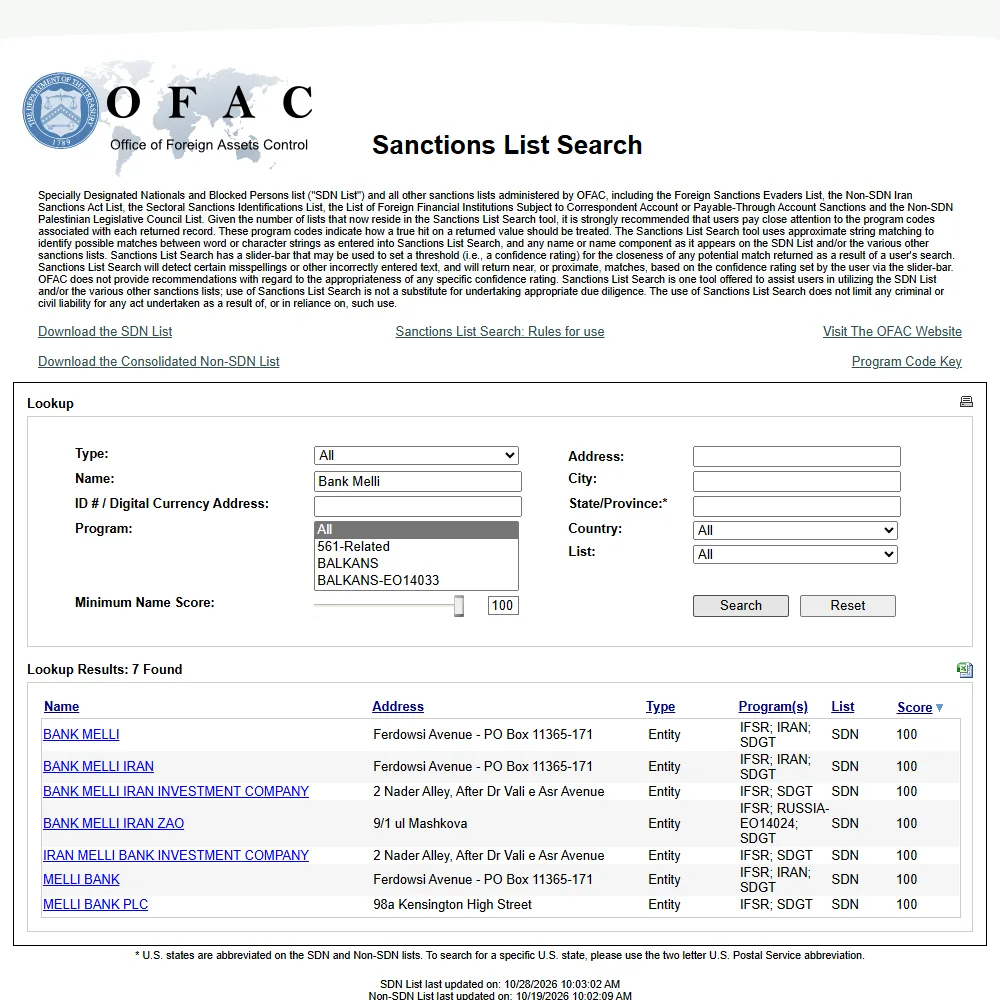
OFAC Sanctions List Search, a name search for Bank Melli (captured 29 October 2026). UK Sanctions List (United Kingdom)
The FCDO's UK Sanctions List search holds every person, entity and ship under UK sanctions, with the regime, the date of designation and the sanctions imposed.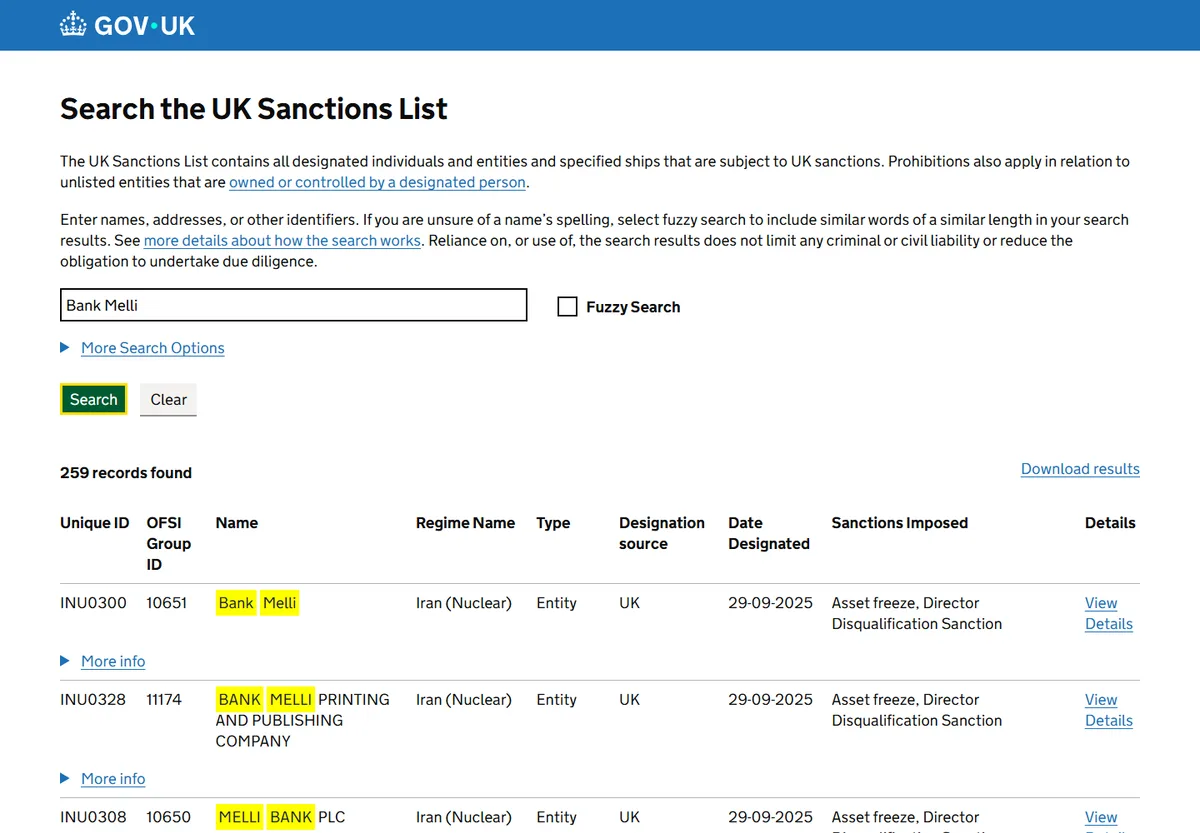
UK Sanctions List search, the same name (captured 29 October 2026). EU Sanctions Map (European Union)
The EU Sanctions Map shows every EU sanctions regime by country and links to the Consolidated List of Financial Sanctions, which holds the names.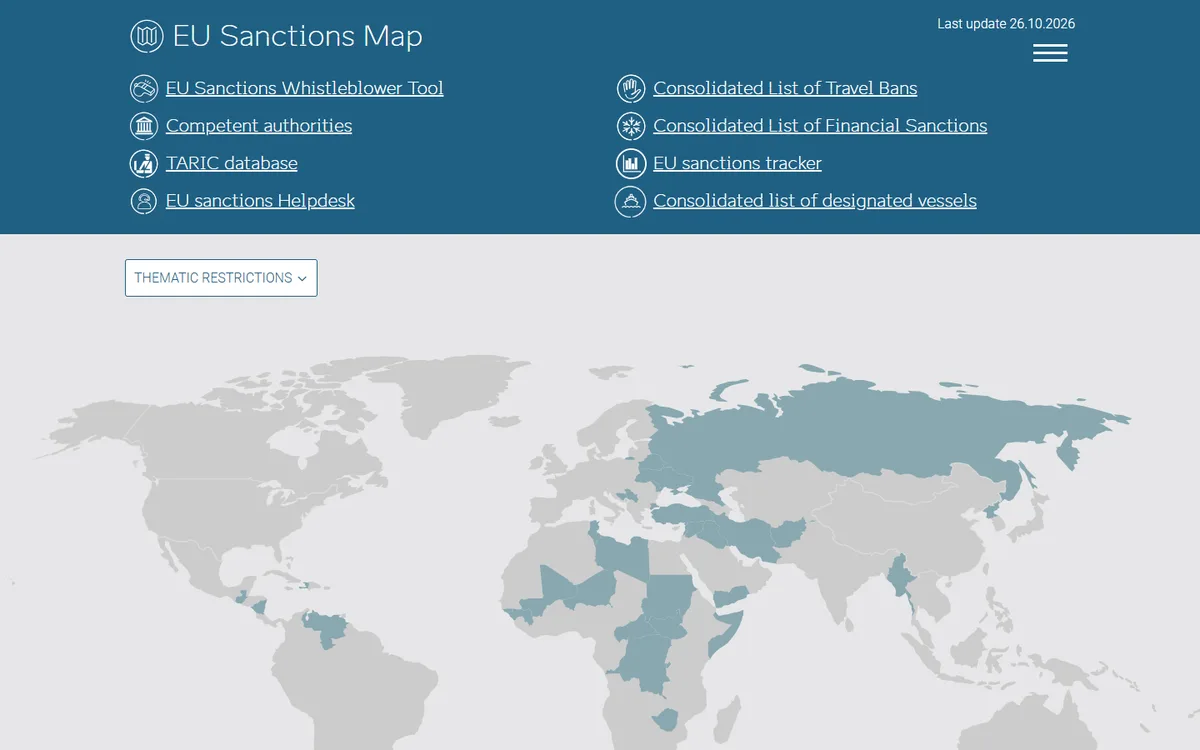
EU Sanctions Map (captured 29 October 2026). Our free pre-checks, without personal data
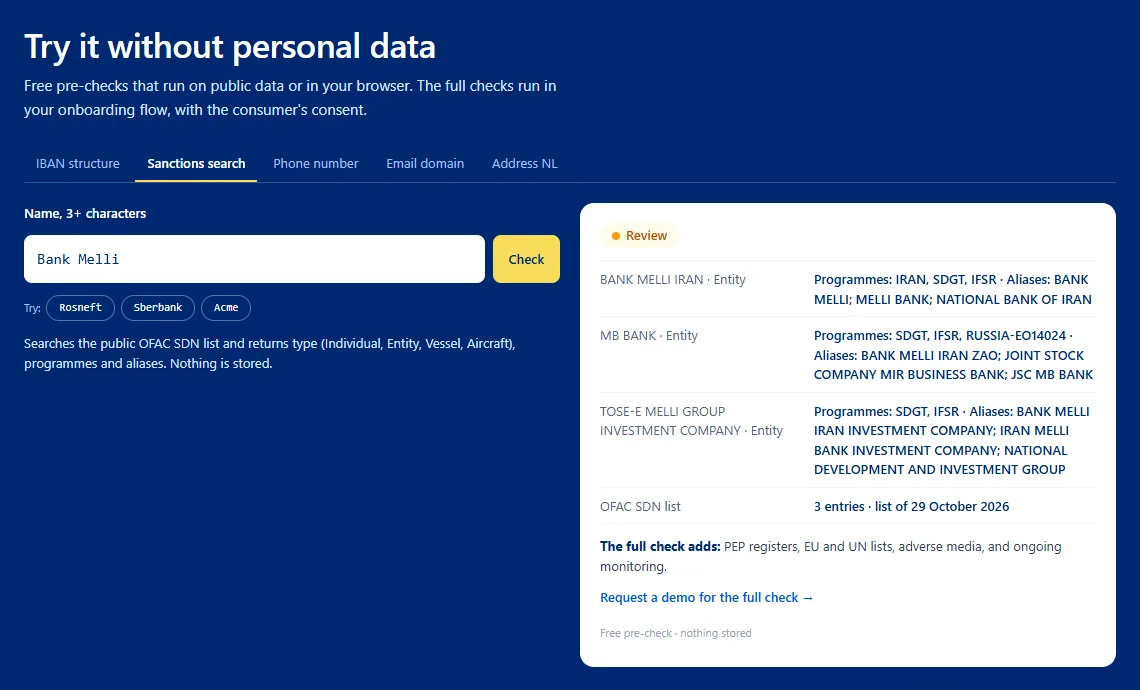
On our consumer checks page you can search the OFAC list, check an IBAN, a phone number, an email domain and a Dutch address for free. Nothing is stored. The full checks run in your onboarding flow, with the customer's consent.
KYC for banks, fintech, crypto and other industries
- Banks. KYC in banking is the strictest: identity, CDD on every account, EDD for PEPs, and ongoing transaction monitoring.
- Fintech and payments. Payment and e-money institutions run the same CDD, usually fully online, and confirm the account holder before payouts.
- Crypto. Crypto-asset service providers are obliged entities in the EU and run customer due diligence like a bank.
- Insurance and lending. Life insurers and lenders verify identity and screen applicants before the contract is signed.
- Gambling. Operators verify identity and age at registration and screen players.
- Marketplaces and platforms. Not always obliged, but sellers and payout recipients get the same checks to stop fraud and repeat accounts.
How to automate KYC checks
Automated KYC means the customer completes the checks themselves, in a flow in your branding, and your systems receive one result per step. You compose the flow once: which checks, in which order, and what a fail means. Our customer onboarding software does that without code, with person validation in 32 markets and the ID scan and screening worldwide. A platform fee from €500 per month, then from €0.15 per check at volume.
Consumer verification
Every KYC check on one platform, with coverage, prices and free pre-checks.
See the checksIdentity verification API
ID card, driving licence or passport scan with a liveness selfie, from any country.
See the ID scanOnboarding flows
Compose your KYC flow from the building blocks, in your branding, without code.
See the flow builder