
1. Why there is no US company register
Company law in the US is state law. A business incorporates in one state, not necessarily where it operates, and registers again as a "foreign" entity in each additional state where it does business. Every state runs its own registry, its own search portal, its own fee schedule and its own definition of what is public. There is no national company number: the closest thing, the federal EIN tax ID, has no public register at all.
The result is a three-layer system: state registries prove existence and good standing, SEC EDGAR holds full financials but only for public companies, and industry regulators (FDIC for banks, state insurance commissioners) leak financial data for regulated sectors. For the ordinary private business, no layer publishes revenue.
| Layer | What it holds | Access |
|---|---|---|
| 50 state registries Secretary of State portals | Entity name, file number, status, formation date, registered agent; officers vary by state | Search mostly free; reports and certificates paid |
| SEC EDGAR sec.gov/edgar | Full filings of SEC registrants: 10-K annual reports, 10-Q, 8-K, plus Form D private fundraise notices | Free, full-text searchable |
| Industry regulators FDIC, Fed, state commissioners | Financial reports for regulated sectors: banks, insurers, utilities | Free, sector-specific portals |
One more absence worth naming: beneficial ownership. The Corporate Transparency Act register is not public, and since 2025 US domestic entities are exempt from reporting to it, so a Delaware or Wyoming LLC can be effectively anonymous.
2. Searching Delaware, the state that matters most
Around two thirds of the Fortune 500 and some two million other entities are incorporated in Delaware, most operating elsewhere. Its search at icis.corp.delaware.gov is free, and it comes with a trap worth knowing.
Open the General Information Name Search
Go to the Division of Corporations site and enter the entity name.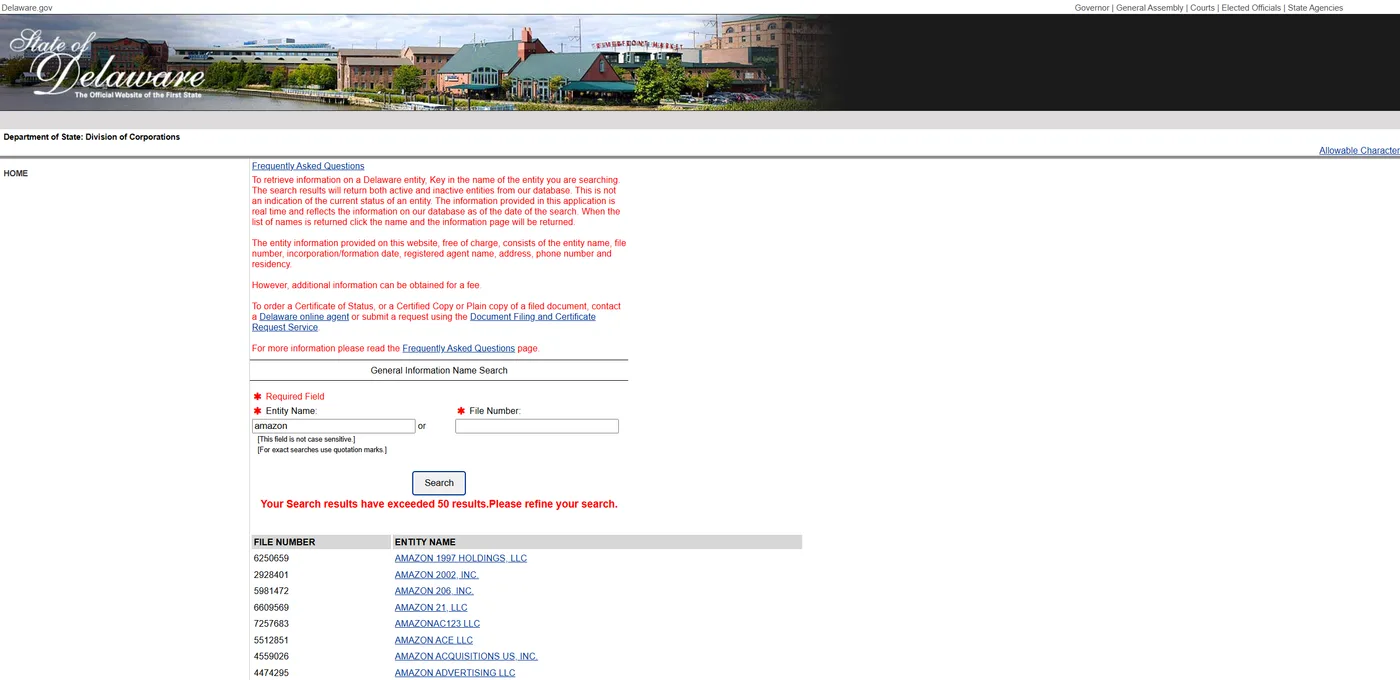
A search for "amazon" exceeds the 50-result cap and lists entities alphabetically: AMAZON 1997 HOLDINGS, AMAZONAC123 LLC, with none of the Amazon you mean in sight. Mind the alphabetical trap
Results are sorted alphabetically with no relevance or size ranking. Search "Amazon" and the first 50 results contain none of Jeff Bezos's entities, just every name starting with those letters, from AMAZON 1997 HOLDINGS to AMAZONBLEND.COM INC. Use the exact registered name ("Amazon.com, Inc.") or the file number. For mapping which entity in a group you actually need, a corporate-structure view beats the state search.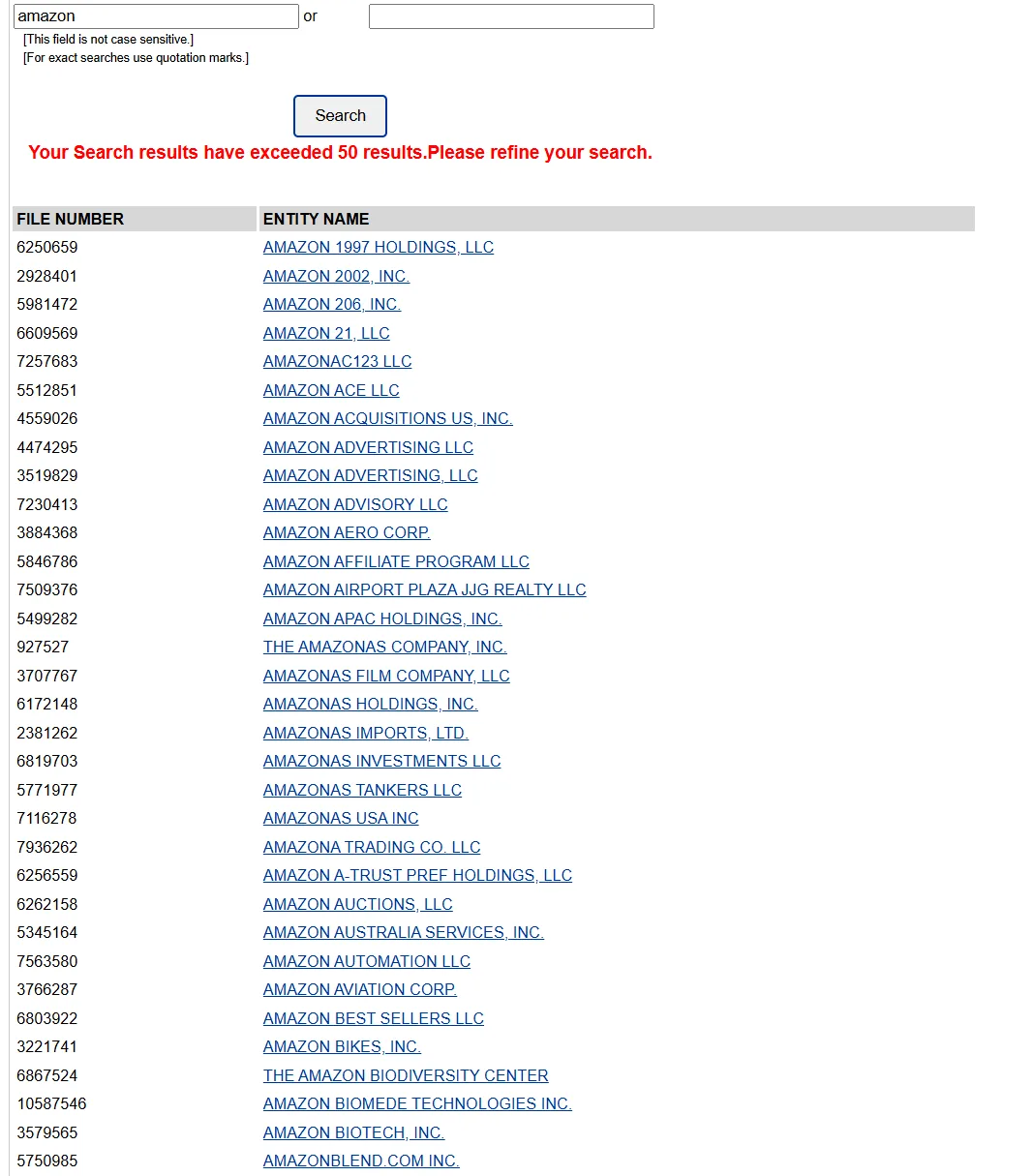
The alphabetical trap in full: from AMAZON 1997 HOLDINGS to AMAZONBLEND.COM INC., fifty entities deep, and still no Amazon.com, Inc. Open the entity record
Free of charge you get the entity name, file number, incorporation date and state, entity type (LLC, corporation), and the registered agent with address, often The Corporation Trust Company at 1209 Orange St, Wilmington, the address shared by hundreds of thousands of entities.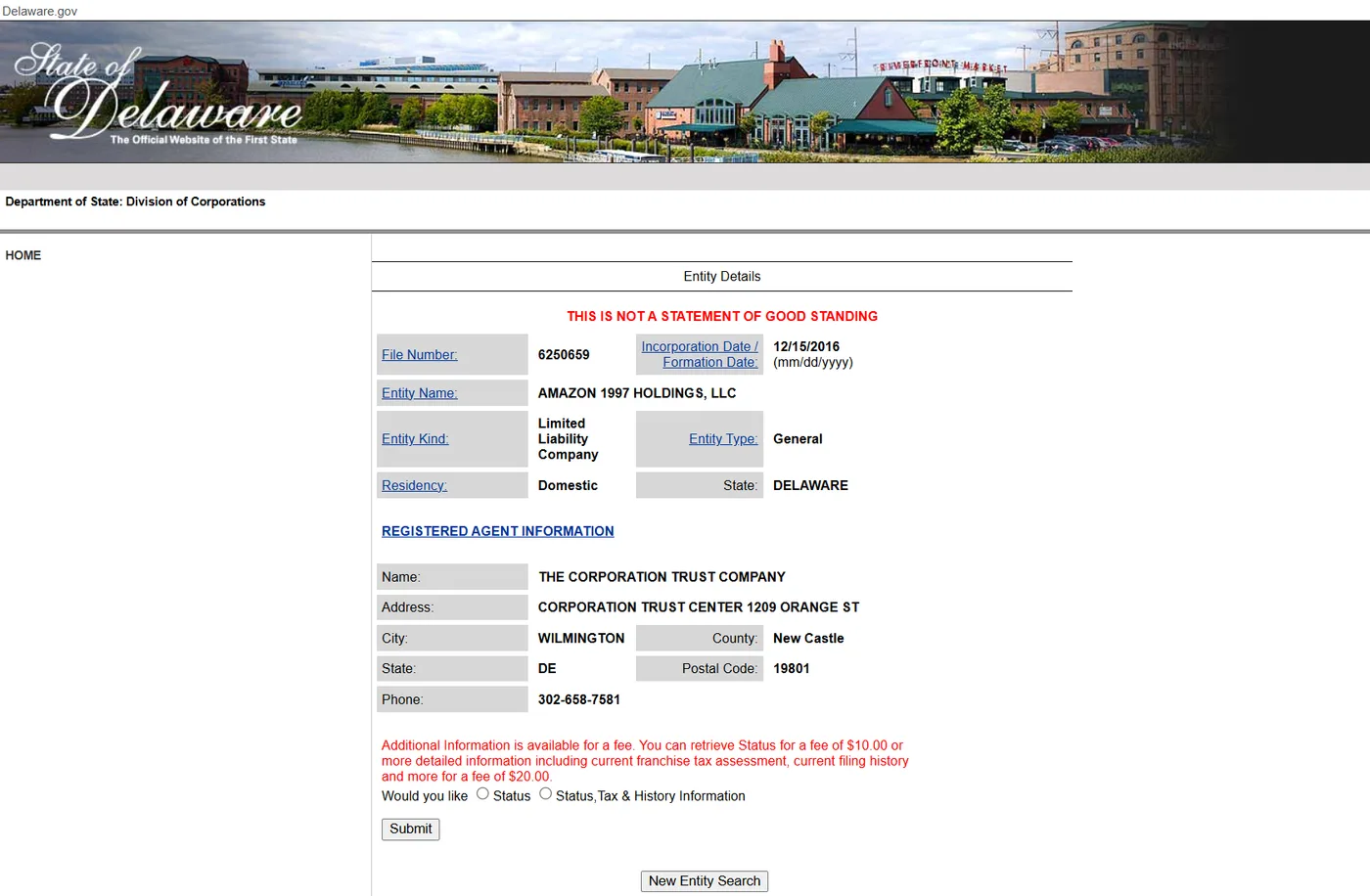
The free Delaware record: file number, formation date, type, and the registered agent, here The Corporation Trust Company at 1209 Orange St, Wilmington, the address shared by hundreds of thousands of entities. Status costs $10 extra, filing history $20. Pay for depth if you need it
A status report costs $10, a detailed report with officer and director names (where filed) $20, and a certificate of good standing $50. Shareholders appear nowhere at any price.
3. The other 49: state-by-state searches
Every state runs its own portal, and they vary wildly. Some are modern, some demand captchas and logins, some charge for any detail. These are the searches you will use most, with a direct free alternative for each:
| State | Official registry | Known for | Easy search |
|---|---|---|---|
| Delaware | Division of Corporations (icis.corp.delaware.gov) | Incorporation capital; alphabetical-only search | Delaware business search |
| California | bizfile Online (Secretary of State) | Largest state economy; filings imaged online | California business search |
| Texas | SOSDirect (Secretary of State) | Official search behind a $1-per-search paywall | Texas business search |
| New York | Department of State entity search | Corporations and LLCs; sparse records | New York business search |
| Illinois | CyberDriveIllinois (Secretary of State) | Corp and LLC databases split in two | Illinois business search |
| Georgia | Georgia Corporations Division | Officer names shown free, rare among states | Georgia business search |
All fifty states, structured the same way and searchable without captchas or per-search fees: US business search by state.
4. SEC EDGAR: where US financials actually live
For the roughly 800,000 entities that have ever registered with the SEC, EDGAR (sec.gov/edgar) is a gift: every 10-K annual report, quarterly 10-Q and 8-K event filing, free and full-text searchable. If the business is listed, you will find audited revenue, profit, segments and risk factors in more detail than any European register offers.
For private businesses, EDGAR offers one narrow window: Form D, the notice filed when raising capital under Regulation D. It reveals that a raise happened, the amount, and the officers, but never revenue. Beyond that, a private US business simply has no public financial trail, which is why US revenue data is modelled from other signals.
Working with EDGAR programmatically? It has free official APIs; our SEC EDGAR API page covers how they work and what they can and cannot return.
5. How to verify a US company: a practical checklist
Find the state of formation
Ask for it, read it off a contract, or work backwards from where the business claims to be. Remember: formation state and operating state are usually different. Our free company lookup resolves this in one search across all states.Confirm the entity in the state registry
Match the exact legal name and file number, and check the status is active or in good standing. Search the exact registered name, because state searches rank nothing.Check foreign qualifications
A business operating in a state where it is not registered as a foreign entity is a flag in itself. Qualification filings also carry a real business address, unlike the registered agent.Cross-check EDGAR
Full financials if it is an SEC filer; Form D history if it raised private capital. Absence from EDGAR is normal for private businesses; presence tells you a lot.For regulated sectors, ask the regulator
Banks file with the FDIC and Federal Reserve, insurers with state commissioners, brokers with FINRA. Regulated industries publish what the company register never will.
6. Limitations of the official sources
Each state portal works for confirming one entity in that state. The structural limits:
- No financials, anywhere. Private businesses file no accounts with any public body, the deepest gap of any major economy, and the reason revenue must be modelled.
- Fifty portals, fifty formats. No shared identifier, no shared schema, paywalls and captchas in several states, and the same name free in fifty places.
- Search is literal. Alphabetical listings and exact-prefix matching, the Amazon problem, make name-based discovery unreliable.
- Ownership is dark. No public UBO register, shareholders in no state record, and registered agents masking real addresses.
- Group structures are invisible. Which of the 200 "Amazon" entities is the parent, and which the subsidiary you are contracting with, no state search will tell you.
Confirming one Delaware LLC exists takes two minutes. Anything past existence, whether revenue, structure or footprint, is where the official sources stop.
7. Access US company data programmatically
The SEC's EDGAR APIs are free and excellent for filers, see our SEC EDGAR API guide. The state registries are another story: no shared API, several states with no API at all, and the ones that exist returning fifty different schemas.
CompanyData maintains records for all 64,593,043 US businesses, sourced from the state registries, SEC filings and other official sources, resolved into one schema: state file numbers reconciled, group structures mapped, and revenue and employee figures as structured fields. The Company Data API serves them by name, state or address, with free trial credits to start, and the same request shape covers 200+ other countries.
Example: look up a company by name and state
GET /api/company/search?country=US&state=DE&name=Blue+Ridge+Logistics

{
  "name": "BLUE RIDGE LOGISTICS LLC",
  "legalForm": "Limited Liability Company",
  "state": "Delaware",
  "status": "Active",
  "naics": "484110 · General freight trucking",
  "employees": "50 to 100",
  "revenueRange": "$10M to $50M"
}
8. US vs other company registers
The US is the outlier on both axes: the most fragmented search and the least public financial data.
| Country | Register | Free search | Official API | Financials public |
|---|---|---|---|---|
| United States | 50 state registries + SEC EDGAR | Mostly, per state | EDGAR only | SEC filers only |
| Argentina | IGJ (Buenos Aires City), per province elsewhere | No, open data and CUIT check only | No, CSV open data (CC BY 4.0) | Paid copy, 6 modules (ARS 9,000) |
| Australia | ASIC + ABR (ABN Lookup) | Yes, incl. sole traders | ABN validation only | Large companies only |
| Austria | Firmenbuch, one FN number | Summary only | No, ten agents resell | Yes, EUR 1.52 per document |
| Belgium | CBE / KBO / BCE | Yes, incl. directors and NACE | Yes, EUR 50 per 2,000 | Yes, free in XBRL |
| Brazil | CNPJ (Receita Federal), one 14-character number per establishment; legal acts at 27 state Juntas Comerciais | By CNPJ only, hCaptcha, incl. QSA | Yes, Serpro, from BRL 0.6591 per lookup; free bulk open data | Listed companies only, free via CVM |
| Bulgaria | Commercial Register (Registry Agency), one 9-digit UIC | Yes, incl. directors and capital | Yes, by contract, from EUR 51.13 | Yes, free download |
| Canada | Corporations Canada + 13 provincial/territorial registries | Yes, incl. directors and ISC | Yes, lookup by number, account needed | Rarely, some distributing corporations |
| Chile | RES (Tu Empresa en un Día) + Registros de Comercio | RES only, behind reCAPTCHA | No; yearly open-data CSV of RES formations | Open and special S.A.s only |
| China | GSXT (SAMR), one 18-character code | Yes, behind a CAPTCHA | None found on GSXT | Ten figures, only if the company opts in |
| Colombia | RUES, 58 chambers of commerce | Basic data, free by law | No; monthly open data on datos.gov.co | Supersociedades filers only (SIIS) |
| Czech Republic | Obchodní rejstřík, 7 courts, one IČO | Yes, incl. extracts, Czech only | Yes, free (ARES REST) | Yes, free as PDF |
| Denmark | CVR, one 8-digit CVR number | Yes, incl. directors and signing rule | Yes, free, by application | Yes, free in XBRL and PDF |
| Estonia | Äriregister via e-Business Register (RIK) | Yes, incl. shareholders and tax data | Yes, free with a RIK contract | Yes, free PDFs + CSV key figures |
| Finland | YTJ + PRH Trade Register, one Business ID | Yes, extract free too | Yes, free open data | Yes, EUR 5.02 per document |
| France | RNE at INPI + Sirene + RCS | Yes, most data | Yes, two, both free | About 45% filed confidentially |
| Germany | Handelsregister, ~150 courts | Yes, since 2022 | No | Yes, via Unternehmensregister |
| Greece | GEMI, one 12-digit number | Yes, incl. directors and filings | Yes, key on approval | Yes, free download |
| Hungary | Cégjegyzék, 20 company courts | Yes, CAPTCHA, Hungarian only | XML by contract, paid | Yes, free to view |
| India | MCA21 (MCA), one CIN, 32 RoC offices | CIN lookup only, CAPTCHA | No | Yes, INR 100 to view, login needed |
| Indonesia | AHU Online (Ditjen AHU), searched by name | Name search only, behind reCAPTCHA | None found; bulk IDR 5m per 100 PTs | Audited PTs only by law; access unconfirmed |
| Ireland | CRO, searched on CORE | Yes, profile and filing list | Yes, free (Open Services) + open data | Yes, EUR 2.50 per document |
| Israel | Registrar of Companies (ICA), one 9-digit number | Yes, Hebrew only, no people | Open data only, free (data.gov.il) | No, public companies via MAGNA |
| Italy | Registro Imprese, Chambers of Commerce | Basic data only | Yes, by contract | Yes, EUR 2.50 per filing |
| Japan | Commercial register (MOJ) + NTA corporate number site | Name, address, number only | Yes, free (NTA, ID takes 2-4 weeks) | EDINET filers only |
| Luxembourg | RCS at Luxembourg Business Registers | Record free, filings need a login | Yes, EUR 5,000 a year | Yes, but many forms exempt |
| Malaysia | SSM, sold via 4 service portals | Match count only | No, e-Info API on enquiry | Yes, summary in RM15.40 profile |
| Mexico | Registro Público de Comercio (SIGER 2.0), one folio mercantil electrónico | No, account and CURP required; state fees may apply | No, terms forbid extraction | Rarely, PSM only at shareholders' request (SAS must file) |
| Netherlands | KVK Handelsregister | Search free, extracts paid | Yes, paid | Filed, paid access |
| New Zealand | Companies Register (Companies Office), company number + NZBN | Yes, incl. directors, shareholders, documents | Yes, mostly free (NZBN API no fee) | FMC and large overseas-linked only |
| Norway | Brønnøysundregistrene (CCR + Foretaksregisteret), one 9-digit number | Yes, incl. roles and firmaattest | Yes, free (NLOD 2.0), no sign-up | Yes, free PDF download |
| Poland | KRS, one 10-digit KRS number (+ CEIDG for sole traders) | Yes, extracts free too | Yes, free, no key | Yes, free, XML unless IFRS |
| Portugal | Registo Comercial (IRN), one NIPC | Publications only, record EUR 25 a year | No, FCPC by protocol only | Filed, separate paid certificate |
| Romania | Registrul Comerțului (ONRC), CUI + J/C/F number | Basic record, free account needed | No, free monthly open data instead | Filed; key figures via ANAF by CUI |
| Saudi Arabia | Commercial Register (Ministry of Commerce), one unified national number | Yes, basic data behind a CAPTCHA | Yes, Wathq, SAR 2-12 per call, prepaid from SAR 5,000 | Filed on Qawaem, not in the free search |
| Singapore | ACRA Bizfile, one UEN per entity | Yes, basic record, no login | Yes, paid subscription, prices unpublished | Yes, extracts from S$11; solvent EPCs exempt |
| Slovakia | ORSR, 8 registry courts, one IČO | Yes, incl. directors and s.r.o. partners | Yes, free (Open Data REST) | Yes, free in RÚZ |
| South Korea | Commercial registry (courts, via IROS), 13-digit corporate number | No, KRW 700 per online view | No, statistics API only; bulk data by approval | Audited and listed companies, free on DART |
| Spain | Registro Mercantil, per province | Yes, core record | No | Yes, paid per filing |
| Sweden | Bolagsverket, one organisation number | Basic record, no board | Yes, free basic data; full API paid | Yes, SEK 75; digital AB filings free since 2020 |
| Switzerland | Zefix + 26 cantons | Yes, 4 languages | Yes, free (Zefix REST) | No |
| Taiwan | MOEA findbiz, one 8-digit UBN | Yes, incl. directors' shareholdings | Yes, free (GCIS open data) | Public companies only, via MOPS |
| Thailand | DBD DataWarehouse+, one 13-digit number | Yes, incl. directors (Thai view only) | BDEX, by application, fees set by law | Yes, key figures free, 5 years |
| Turkey | Ticaret Sicili, 238 offices in MERSİS, one MERSİS number | Name check only (image code); notices free with login | No free API; paid gazette web-service feed from TRY 484,932/yr | No accounts search; listed companies on KAP |
| United Arab Emirates | NER (Ministry of Economy) + per-emirate and free zone registers | No national search (UAE PASS); Dubai directory and DIFC free | None found; Dubai licence CSVs on Dubai Pulse (unreachable) | Joint stock companies only |
| United Kingdom | Companies House | Yes | Yes, free | Yes, but often no P&L |
| Vietnam | National Business Registration Portal (MoF), one enterprise code = tax code | Yes, basic record behind a reCAPTCHA | None found; paid account access (VND 4.5m/month) | Yes, VND 40,000 per copy |