
1. What is the South Korean company register?
South Korea's company register is the commercial registry (상업등기), and it belongs to the courts, not to a ministry or a chamber of commerce. A company registers with the district court, branch court, or registry office (등기소) that covers its head office. It only comes into existence once that registration is made, and under the Commercial Act a fact that should be registered cannot be held against a third party acting in good faith until it is. The register is the legal record, not a courtesy listing.
The records are fully electronic. The Court Administration (법원행정처) runs a central office for registry information that handles every online view and certificate, and the public reaches it through IROS, the Internet Registry Office (인터넷등기소), which serves the real estate and corporate registries side by side. Online reading of the corporate registry started in February 2001, and the computerisation of corporate records was completed in September 2003. What the register does not hold is the tax and accounts side of a company: tax registration sits with the National Tax Service, and audit reports and other disclosures on DART, the Financial Supervisory Service's disclosure system.
| System | What it holds | Access |
|---|---|---|
| Corporate registry via IROS iros.go.kr | Trade name, head office, purposes, capital and shares, directors and auditors, the representative director, the method of public notice, branches, dissolution and liquidation | Paid per record, KRW 700 to view online |
| Business registration, National Tax Service status service on data.go.kr | The 10-digit business registration number, whether the business is continuing, suspended, or closed, the closure date, and the tax type | Free status API, no company name returned |
| DART, Financial Supervisory Service dart.fss.or.kr | Audit reports of companies above the audit thresholds, business reports of listed companies, and a company overview with both numbers | Free to search, free Open DART API |
In short: the court registry tells you a company exists and who may bind it, the tax office tells you whether it is still trading, and DART tells you how it performs, if it is big enough to file there.
2. How to search IROS step by step
IROS is where the court registry is read online, and reading a record there is never free. When we tried it for this guide, searching for Samsung Electronics, IROS asked for a login and payment before it would show an extract, and it required installing a security program, TouchEn nx, first. We did not get past that point, so the steps below combine what the portal shows with what the Commercial Registration Rules say happens next.
Open IROS
The home page is in Korean. The main menu reads 열람·발급 (view and issue), 신청 (apply), 등기지원 서비스 (registry support), 나의 등기정보 (my registry information), and 고객센터 (customer centre), with 로그인 (log in) and a KOR language menu at the top right. The English option in that menu opens a short English introduction to the registry system (four pages), not an English search.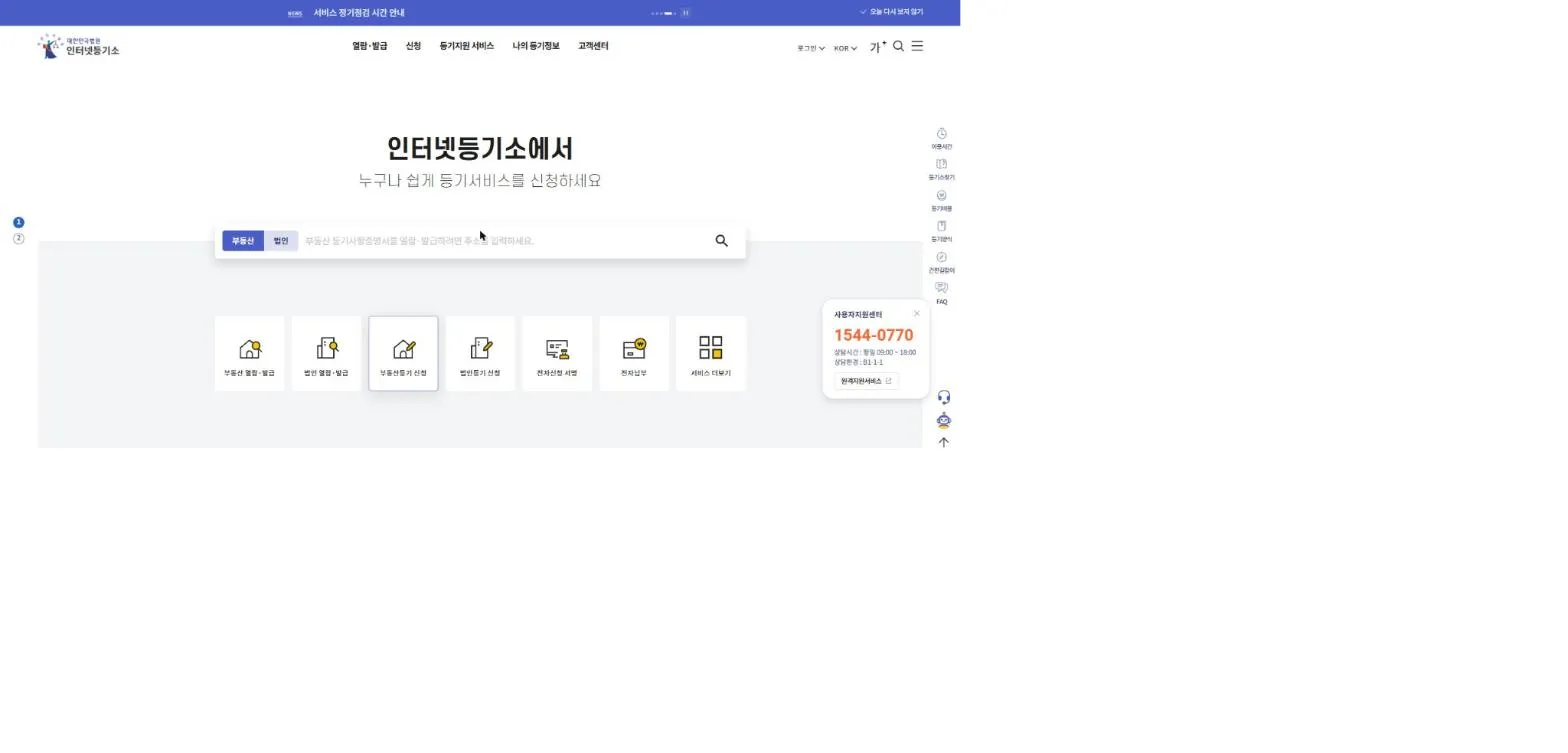
The IROS home page. The search box opens on the real estate tab (부동산); companies sit under the second tab, 법인, and behind the 법인 열람·발급 tile below it. Login and the KOR language menu are at the top right. Switch to 법인 and search in Korean
Select the 법인 (corporation) tab or the 법인 열람·발급 tile. Search with the company's Korean name: the register is kept in Hangul and Arabic numerals, and Roman letters may only be added in parentheses after the Korean. If you only have the English name, get the Korean one first from the company's own documents or from DART, which lists Samsung Electronics as 삼성전자(주).Pick the right company
Match the head office as well as the name. Trade-name protection in Korea is local: the Commercial Act only bars registering a name that someone else has already registered for the same kind of business in the same city or county, so the same name can be on record in another city or for another business.Choose a view or a certificate, and which version
A view (열람) shows the record on screen for KRW 700. A certificate (발급) costs KRW 1,000 online and is the version that carries the certification that it matches the register, the issue date, and an electronic seal. Certificates come as a full record (등기사항전부증명서) or a partial one (등기사항일부증명서), each in three versions: current entries only (현재 유효사항), including cancelled entries (말소사항 포함), or a closed record (폐쇄사항).Log in, install the security program, and pay
This is where our attempt stopped. IROS wanted a login and the TouchEn nx security program before it would show an extract. Online fees are paid by credit card, bank transfer, or electronic money. If you get stuck, the IROS user support centre is on 1544-0770, weekdays from 09:00 to 18:00.
3. What data is public and what it costs
The law is open-handed about who may look: anyone may view a record and obtain a certificate, at any registry office, not only the one that keeps the company. It is strict about price. Every view and every certificate carries a fee set by Supreme Court rule, and the rule says expressly that the general fee exemptions do not cover the online fees.
| Item | Free or paid | Price |
|---|---|---|
| Viewing a corporate record online (열람) | Paid | KRW 700 per record |
| Certificate online or at a kiosk (발급) | Paid | KRW 1,000 per copy |
| Certificate at a registry office counter | Paid | KRW 1,200 per copy up to 20 pages, KRW 50 per extra page |
| Viewing a record at a registry office | Paid | KRW 1,200 per record |
| Application documents behind an entry (부속서류) | Restricted | Only the parts you have an interest in; online only for the company's representative or its lawyer or judicial scrivener |
| Bulk registry data (등기전산정보자료) | Paid, by approval | KRW 10,000 per request plus KRW 20 per record above 20 |
| Registry statistics and Open API (등기정보광장) | Free | KRW 0, statistics only, 1,000 calls a day |
| Business status check, National Tax Service | Free | KRW 0, up to 100 numbers per call |
| DART filings and the Open DART API | Free | KRW 0, for companies that file there |
The prices are small, but there is no free tier for company records at all. Checking fifty suppliers means fifty payments, and keeping a list current means paying again every time you look. The bulk route is not a shortcut either: registry data in bulk needs a review by the competent ministry and approval from the Court Administration, and the request must be limited to the minimum data the purpose needs.
What you will not find in the register: revenue, employee counts, contact details, or financial statements. A stock company keeps its accounts at its head office and must announce its balance sheet once it is approved, using the notice method in its articles: the Official Gazette, a daily newspaper, or electronically if the articles allow it. The central source of accounts is DART, which carries the filings of listed companies and the audit reports of companies subject to external audit: listed companies, any company with assets or revenue of KRW 50 billion or more, and stock companies that reach two of the following: assets of KRW 12 billion, liabilities of KRW 7 billion, revenue of KRW 10 billion, or 100 employees. Limited companies are tested on three of five, the fifth being 50 members.
4. South Korean legal forms, briefly
The Commercial Act allows exactly five kinds of company, and the register keeps a separate book for each, plus one for foreign companies. Those books sit next to others for trade names, minors, legal representatives, managers, and limited partnership associations.
| Form | Korean name | Register book | In short |
|---|---|---|---|
| Stock company | 주식회사 | 주식회사등기부 | The standard company form. Shareholders are liable up to the subscription price of their shares; each par-value share is at least KRW 100, and no-par shares are allowed if the articles say so. The Commercial Act defines a listed company as a stock company whose shares are listed, so Samsung Electronics, listed under stock code 005930 and shown on DART as 삼성전자(주), is one. |
| Limited company | 유한회사 | 유한회사등기부 | Members are liable up to their contribution, in units of at least KRW 100. External audit applies on size tests that also count the number of members. |
| Limited liability company | 유한책임회사 | 유한책임회사등기부 | Added to the Commercial Act in 2011. Members are liable up to their contribution, and the managers who run it (업무집행자) are registered by name. |
| General partnership company | 합명회사 | 합명회사등기부 | At least two members draw up the articles. If the company cannot pay its debts, the members are jointly liable for them. |
| Limited partnership company | 합자회사 | 합자회사등기부 | Members with unlimited liability alongside members liable only up to their contribution. The register records which is which. |
| Foreign company | 외국회사 | 외국회사등기부 | Must appoint a representative in Korea and either open a place of business or have a representative living there. A place of business is registered within three weeks. |
| Limited partnership association | 합자조합 | 합자조합등기부 | Not a company but a contract between managing partners with unlimited liability and partners with limited liability. Registered all the same. |
Sole traders do not get a company record. An individual merchant shows up only in the other books: a registered trade name, a manager it appoints, or a minor or legal representative who runs a business, which the Commercial Act requires to be registered.
5. How to verify a South Korean company: a practical checklist
Confirm the corporate registration number and the Korean name
Ask the counterparty for its 13-digit corporate registration number and its registered name in Korean, then check both against DART's company overview, which shows the corporate and business registration numbers side by side for companies that file there. For a quick first pass, our free company lookup finds the registration and revenue data in one search.Check the tax status with the National Tax Service
Run the 10-digit business registration number through the NTS business status service. It tells you whether the business is continuing (계속사업자), suspended (휴업자), or closed (폐업자), with the closure date and the tax type. Its validation call goes further and checks the number against the opening date and the representative's name.Buy the current certificate and read the board
The full certificate with current entries (등기사항전부증명서, 현재 유효사항) lists the registered directors and auditors and the representative director, whose name and address are registered. Check that the person signing is there. Under the Commercial Act, a change that should have been registered but was not cannot be held against a third party acting in good faith, so the certificate is what you can rely on.Pull the version with cancelled entries
The version including cancelled entries (말소사항 포함) shows what used to be true: former directors, earlier head offices, previous names. Changes must be registered at the head office within two weeks, so a burst of recent entries just before a deal is real and worth asking about.Watch for pending filings and closed records
A certificate marked with a pending application means the record is about to change. A record of a company that was dissolved can be closed ten years later, but closed records are kept permanently and can still be viewed, so a company you cannot find among the current records may still have a closed one.Read the accounts on DART if the company files there
Search DART for the audit report (감사보고서) and, for listed companies, the business report. Audit reports must be open to the public for three years. Check the auditor's opinion and the filing date as well as the figures. A company above the audit thresholds with no audit report on DART is worth a question.
6. Limitations of the official register
To be clear: the court registry is authoritative, and a KRW 1,000 certificate is cheap due diligence. The limits show up when you need a quick look, work in English, or need more than a handful of companies:
- No free view. Every online look at a record costs KRW 700 and every online certificate KRW 1,000, and the general fee exemptions do not apply to them.
- Korean only. Records are kept in Hangul and Arabic numerals, with Roman letters at most in parentheses. The English option on IROS opens an English introduction to the registry system, not an English search.
- Login and security software. When we tried, IROS asked for a login and payment before showing an extract and wanted the TouchEn nx security program installed. On a managed work laptop, that can be the end of it.
- No API for company records. The court's Open API serves registry statistics only. Bulk registry data needs a ministry review and Court Administration approval, and a request must be limited to the minimum data needed.
- No accounts in the register. Financial statements reach DART only through audit reports and the filings of listed companies. Other stock companies announce just a balance sheet, through the notice method in their articles.
- Names are not unique. A trade name is only protected against the same business in the same city or county, so name matching across the country produces false hits.
- Officers' ID numbers can be withheld. Directors are registered with their resident registration numbers, but the rules allow views and certificates to withhold them in full or in part, so you cannot reliably match a person across companies.
- Three numbers, three agencies. The court's 13-digit number, the tax office's 10-digit number, and DART's own 8-digit company code live in separate systems. DART's overview joins the first two for companies that file there; for the rest you join them yourself.
If you check one South Korean supplier a quarter and read Korean, none of this matters much. If you onboard hundreds from abroad, it is the whole problem.
7. Access IROS register data programmatically
CompanyData maintains a normalized database of all 2,683,605 South Korean entities, refreshed as new registrations appear. Records are enriched with revenue, employees, industry codes, and contact data where we hold them, so you do not have to buy a certificate per company to build a list.
Our Company Data API lets you look up any South Korean entity by registration number, name, or address and get structured JSON back in real time, with 150 free lookups to start and no IROS login, security plug-in, or fee per record. It is used by developers, banks, and insurers across 190+ countries, so South Korean checks work exactly like checks anywhere else.
Example: look up a company by name
GET /v1/companies?country=KR&name=Samsung%20Electronics
We have left the response out on purpose. When we searched IROS for Samsung Electronics, the register asked for a login, a payment, and a security plug-in before it would show anything, so this guide has no register record to check a response against, and we do not print values we have not seen on the register. Run the request with your free lookups and compare the result with an IROS certificate yourself.
8. South Korea vs other company registers
South Korea charges for every look at the register and spreads one company across three agencies, while its tax-status check and disclosure system are free. For context:
| Country | Register | Free search | Official API | Financials public |
|---|---|---|---|---|
| South Korea | Commercial registry (courts, via IROS), 13-digit corporate number | No, KRW 700 per online view | No, statistics API only; bulk data by approval | Audited and listed companies, free on DART |
| Argentina | IGJ (Buenos Aires City), per province elsewhere | No, open data and CUIT check only | No, CSV open data (CC BY 4.0) | Paid copy, 6 modules (ARS 9,000) |
| Australia | ASIC + ABR (ABN Lookup) | Yes, incl. sole traders | ABN validation only | Large companies only |
| Austria | Firmenbuch, one FN number | Summary only | No, ten agents resell | Yes, EUR 1.52 per document |
| Belgium | CBE / KBO / BCE | Yes, incl. directors and NACE | Yes, EUR 50 per 2,000 | Yes, free in XBRL |
| Brazil | CNPJ (Receita Federal), one 14-character number per establishment; legal acts at 27 state Juntas Comerciais | By CNPJ only, hCaptcha, incl. QSA | Yes, Serpro, from BRL 0.6591 per lookup; free bulk open data | Listed companies only, free via CVM |
| Bulgaria | Commercial Register (Registry Agency), one 9-digit UIC | Yes, incl. directors and capital | Yes, by contract, from EUR 51.13 | Yes, free download |
| Canada | Corporations Canada + 13 provincial/territorial registries | Yes, incl. directors and ISC | Yes, lookup by number, account needed | Rarely, some distributing corporations |
| Chile | RES (Tu Empresa en un Día) + Registros de Comercio | RES only, behind reCAPTCHA | No; yearly open-data CSV of RES formations | Open and special S.A.s only |
| China | GSXT (SAMR), one 18-character code | Yes, behind a CAPTCHA | None found on GSXT | Ten figures, only if the company opts in |
| Colombia | RUES, 58 chambers of commerce | Basic data, free by law | No; monthly open data on datos.gov.co | Supersociedades filers only (SIIS) |
| Czech Republic | Obchodní rejstřík, 7 courts, one IČO | Yes, incl. extracts, Czech only | Yes, free (ARES REST) | Yes, free as PDF |
| Denmark | CVR, one 8-digit CVR number | Yes, incl. directors and signing rule | Yes, free, by application | Yes, free in XBRL and PDF |
| Estonia | Äriregister via e-Business Register (RIK) | Yes, incl. shareholders and tax data | Yes, free with a RIK contract | Yes, free PDFs + CSV key figures |
| Finland | YTJ + PRH Trade Register, one Business ID | Yes, extract free too | Yes, free open data | Yes, EUR 5.02 per document |
| France | RNE at INPI + Sirene + RCS | Yes, most data | Yes, two, both free | About 45% filed confidentially |
| Germany | Handelsregister, ~150 courts | Yes, since 2022 | No | Yes, via Unternehmensregister |
| Greece | GEMI, one 12-digit number | Yes, incl. directors and filings | Yes, key on approval | Yes, free download |
| Hungary | Cégjegyzék, 20 company courts | Yes, CAPTCHA, Hungarian only | XML by contract, paid | Yes, free to view |
| India | MCA21 (MCA), one CIN, 32 RoC offices | CIN lookup only, CAPTCHA | No | Yes, INR 100 to view, login needed |
| Indonesia | AHU Online (Ditjen AHU), searched by name | Name search only, behind reCAPTCHA | None found; bulk IDR 5m per 100 PTs | Audited PTs only by law; access unconfirmed |
| Ireland | CRO, searched on CORE | Yes, profile and filing list | Yes, free (Open Services) + open data | Yes, EUR 2.50 per document |
| Israel | Registrar of Companies (ICA), one 9-digit number | Yes, Hebrew only, no people | Open data only, free (data.gov.il) | No, public companies via MAGNA |
| Italy | Registro Imprese, Chambers of Commerce | Basic data only | Yes, by contract | Yes, EUR 2.50 per filing |
| Japan | Commercial register (MOJ) + NTA corporate number site | Name, address, number only | Yes, free (NTA, ID takes 2-4 weeks) | EDINET filers only |
| Luxembourg | RCS at Luxembourg Business Registers | Record free, filings need a login | Yes, EUR 5,000 a year | Yes, but many forms exempt |
| Malaysia | SSM, sold via 4 service portals | Match count only | No, e-Info API on enquiry | Yes, summary in RM15.40 profile |
| Mexico | Registro Público de Comercio (SIGER 2.0), one folio mercantil electrónico | No, account and CURP required; state fees may apply | No, terms forbid extraction | Rarely, PSM only at shareholders' request (SAS must file) |
| Netherlands | KVK Handelsregister | Search free, extracts paid | Yes, paid | Filed, paid access |
| New Zealand | Companies Register (Companies Office), company number + NZBN | Yes, incl. directors, shareholders, documents | Yes, mostly free (NZBN API no fee) | FMC and large overseas-linked only |
| Norway | Brønnøysundregistrene (CCR + Foretaksregisteret), one 9-digit number | Yes, incl. roles and firmaattest | Yes, free (NLOD 2.0), no sign-up | Yes, free PDF download |
| Poland | KRS, one 10-digit KRS number (+ CEIDG for sole traders) | Yes, extracts free too | Yes, free, no key | Yes, free, XML unless IFRS |
| Portugal | Registo Comercial (IRN), one NIPC | Publications only, record EUR 25 a year | No, FCPC by protocol only | Filed, separate paid certificate |
| Romania | Registrul Comerțului (ONRC), CUI + J/C/F number | Basic record, free account needed | No, free monthly open data instead | Filed; key figures via ANAF by CUI |
| Saudi Arabia | Commercial Register (Ministry of Commerce), one unified national number | Yes, basic data behind a CAPTCHA | Yes, Wathq, SAR 2-12 per call, prepaid from SAR 5,000 | Filed on Qawaem, not in the free search |
| Singapore | ACRA Bizfile, one UEN per entity | Yes, basic record, no login | Yes, paid subscription, prices unpublished | Yes, extracts from S$11; solvent EPCs exempt |
| Slovakia | ORSR, 8 registry courts, one IČO | Yes, incl. directors and s.r.o. partners | Yes, free (Open Data REST) | Yes, free in RÚZ |
| Spain | Registro Mercantil, per province | Yes, core record | No | Yes, paid per filing |
| Sweden | Bolagsverket, one organisation number | Basic record, no board | Yes, free basic data; full API paid | Yes, SEK 75; digital AB filings free since 2020 |
| Switzerland | Zefix + 26 cantons | Yes, 4 languages | Yes, free (Zefix REST) | No |
| Taiwan | MOEA findbiz, one 8-digit UBN | Yes, incl. directors' shareholdings | Yes, free (GCIS open data) | Public companies only, via MOPS |
| Thailand | DBD DataWarehouse+, one 13-digit number | Yes, incl. directors (Thai view only) | BDEX, by application, fees set by law | Yes, key figures free, 5 years |
| Turkey | Ticaret Sicili, 238 offices in MERSİS, one MERSİS number | Name check only (image code); notices free with login | No free API; paid gazette web-service feed from TRY 484,932/yr | No accounts search; listed companies on KAP |
| United Arab Emirates | NER (Ministry of Economy) + per-emirate and free zone registers | No national search (UAE PASS); Dubai directory and DIFC free | None found; Dubai licence CSVs on Dubai Pulse (unreachable) | Joint stock companies only |
| United Kingdom | Companies House | Yes | Yes, free | Yes, but often no P&L |
| United States | 50 state registries + SEC EDGAR | Mostly, per state | EDGAR only | SEC filers only |
| Vietnam | National Business Registration Portal (MoF), one enterprise code = tax code | Yes, basic record behind a reCAPTCHA | None found; paid account access (VND 4.5m/month) | Yes, VND 40,000 per copy |