
1. What is the Chinese company register?
China does not keep its register in one court or one chamber of commerce. Companies register with a local market supervision administration, and the Alibaba record in this guide names its registration authority as the Hangzhou High-tech Industrial Development Zone (Binjiang) Market Supervision Administration. What every authority registers is then published nationally through the 国家企业信用信息公示系统, the National Enterprise Credit Information Publicity System, at www.gsxt.gov.cn. Shanghai, for example, has its own sub-site under the same name at sh.gsxt.gov.cn.
Two State Council regulations set most of the rules. The Regulations on the Administration of Registration of Market Entities, in force since 1 March 2022, decide who registers and what: companies, non-company enterprise legal persons, sole proprietorship enterprises, partnerships, farmers' cooperatives, individual businesses, and branches of foreign companies. The Interim Regulations on Enterprise Information Disclosure of 2014, revised with effect from 1 May 2024, decide what gets published and by whom. The result is a register that publishes three kinds of information side by side.
| Source | What it holds | Access |
|---|---|---|
| Business licence information from the registration authority | Unified Social Credit Code, company name, type, legal representative, registered capital, date of establishment, registration authority, domicile, business scope, registration status | Free on GSXT, no account |
| Annual report and interim disclosures published by the company itself | Postal address, phone, email, operating status, investments in other companies, shareholder contributions, equity transfers, websites and online shops, and optionally ten financial figures | Public on GSXT, figures only if the company opts in |
| Licences, penalties, and lists from regulators | Administrative licences and penalties, the list of businesses with abnormal operations, and the list of serious violators | Free on GSXT |
In short: the business licence information tells you a company exists and who represents it, the annual report tells you how to reach it and who paid in what, and the lists tell you whether a regulator has flagged it.
2. How to search GSXT step by step
Searching is free and we needed no account to open a company record. Two things stand in the way instead. The register is in Chinese, so you read it through your browser's translation, which is how both screenshots below were made. And you have to solve a CAPTCHA before results appear, which we did by hand.
Open GSXT and use the single search box
The box on www.gsxt.gov.cn takes a company name, a Unified Social Credit Code, or a registration number. Turn on your browser's translation if you do not read Chinese. Registered company names must be written in standard Chinese characters, so a search in Chinese characters or by code is the reliable route.Search by code when you have one
An 18-character code points at exactly one entity in the whole country, so it saves you the result list and the filtering. Ask a Chinese counterparty for it first: it is printed on the business licence, it heads the business licence information on GSXT, and it doubles as the tax number.Solve the CAPTCHA
Results only load after a CAPTCHA, which we solved by hand. It also makes GSXT impractical for checking more than a handful of companies.Narrow the result list
A name search can return a long list. Our search for Alibaba returned more than 100 results and a request to enter more precise search criteria. Each hit shows the name, a status badge, the code, the legal representative, the date of establishment, and a Registration Number field. Use the filters above the list to cut it down by status, years since establishment, registration authority by province, or licensing and penalty records, or switch the search to the abnormal operations list or the serious violators list.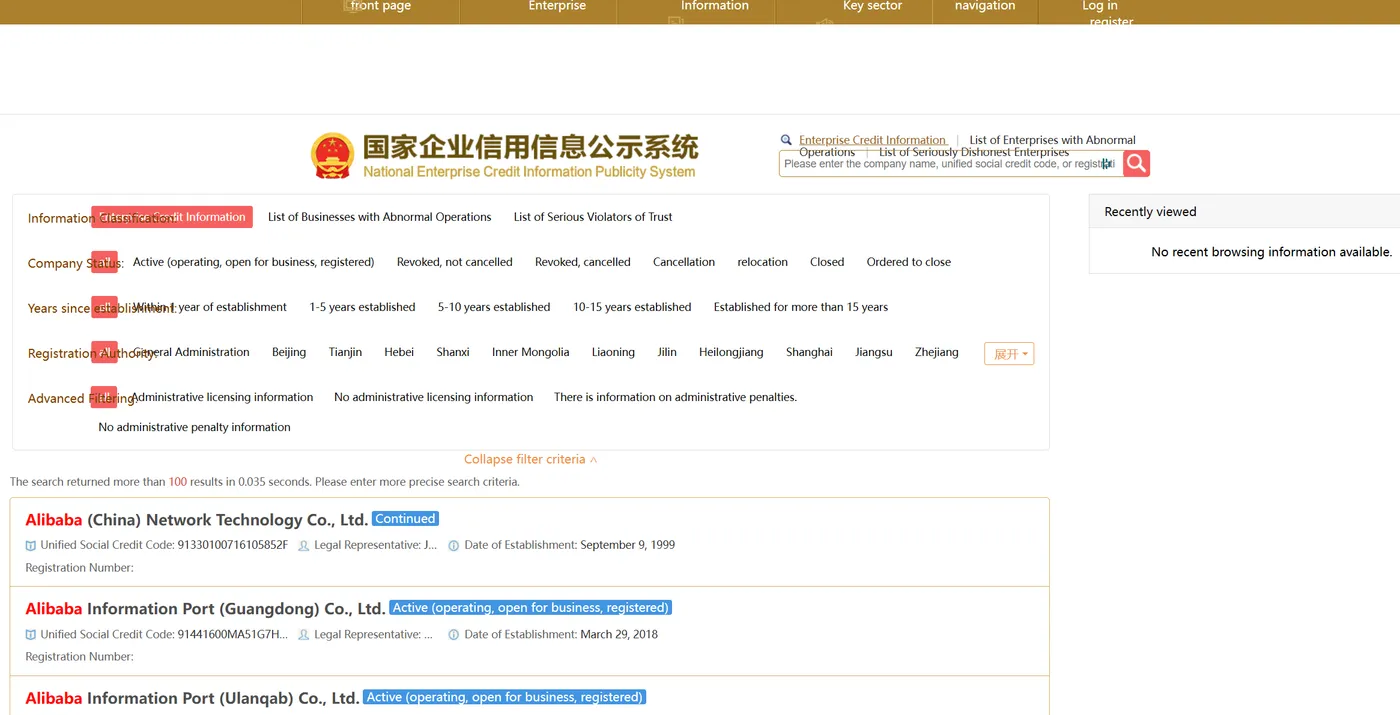
Search results for Alibaba on GSXT, shown through automatic browser translation to English (the register itself is in Chinese). The query returned more than 100 results. The filters cover company status, years since establishment, registration authority by province, and licensing and penalty records. Open the company record
The record opens on the business licence information: code, name, type, legal representative, registered capital, date of establishment, approval date, registration authority, registration status, domicile, and the business scope written out in full. None of it is behind a paywall.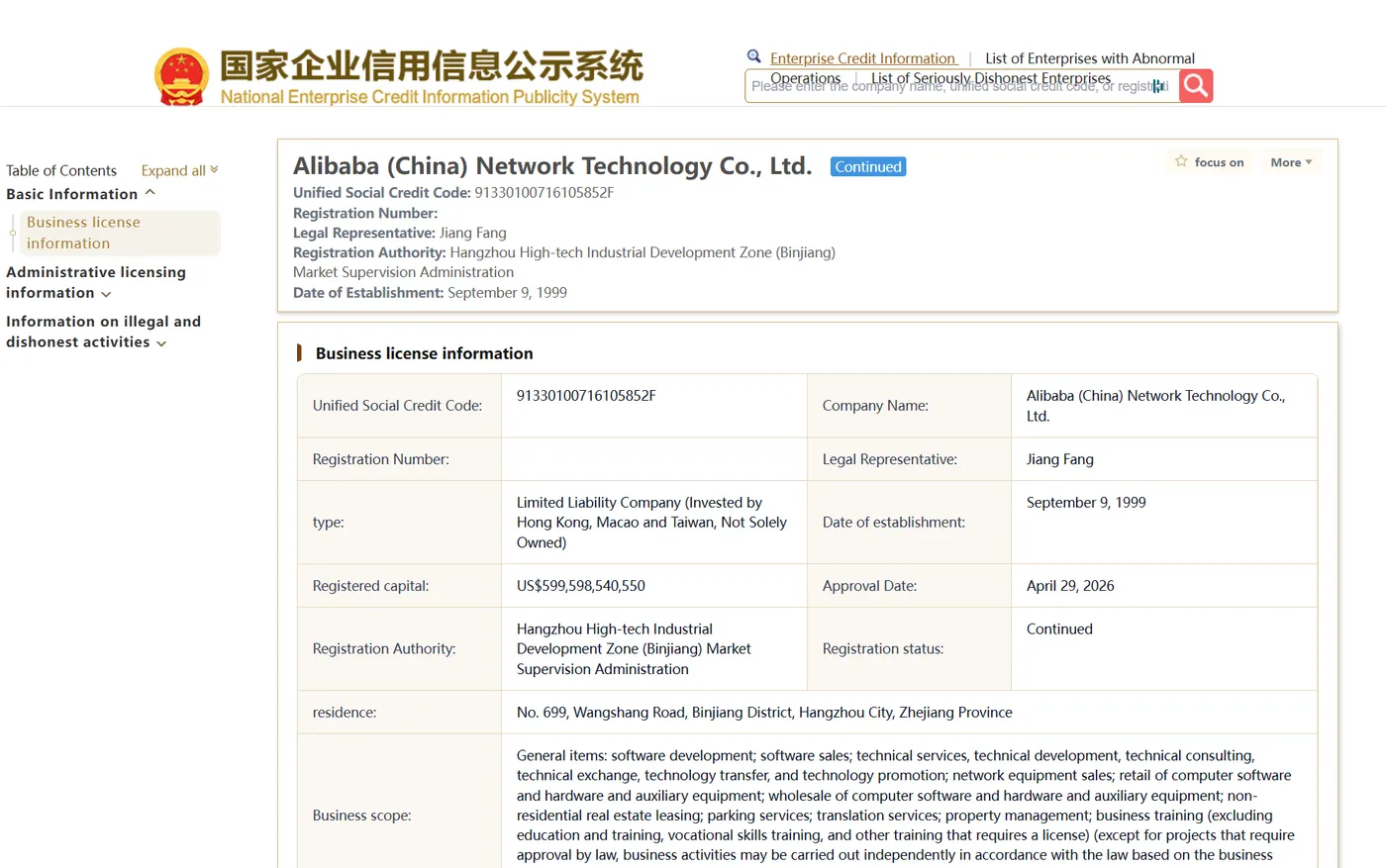
The record for Alibaba (China) Network Technology Co., Ltd., Unified Social Credit Code 91330100716105852F, machine-translated from Chinese by the browser. The legal representative is Jiang Fang, the date of establishment is September 9, 1999, the status reads "Continued", and the Registration Number field is empty. Work through the other sections
The table of contents on the left of the record lists the further sections: administrative licensing information, and information on illegal and dishonest activities. Use Expand all to open them. The law also requires the annual report to be published through this system, although no annual report section is visible in the part of the record we captured.
3. What data is public and what it costs
Searching the Chinese register and opening a company record costs nothing. The price is paid in effort instead: a CAPTCHA, a foreign language, and one company at a time. What makes China unusual is less the price than what the law forces companies to publish, and what it lets them keep back.
| Item | Free or paid | Price |
|---|---|---|
| GSXT search by name or code | Free | No fee, no account, CAPTCHA first |
| Business licence information (code, type, legal representative, capital, scope, status) | Free | No fee, shown on the record |
| Annual report: address, phone, email, websites, shareholder contributions, equity transfers | Public | Must be published on GSXT by law |
| Annual report: employees, assets, liabilities, revenue, profit, tax paid | Public if published | The company decides whether to publish |
| Information the company chose not to publish | On request | Only with the company's consent |
| Administrative licences and penalties | Free | No fee, published within 20 working days |
| Abnormal operations list and serious violators list | Free | No fee, searchable as their own lists |
Two things are worth pulling out of that table. The annual report must publish the company's postal address, phone number, and email address, along with what each shareholder subscribed and actually paid in. And the financial part of the report is ten figures, not a set of accounts: employees, total assets, total liabilities, guarantees given, owners' equity, total revenue, main business revenue, total profit, net profit, and total tax. Each company decides whether the public sees them.
What the GSXT annual report does not ask for: a set of financial statements. Every company draws up annual financial reports, but a limited liability company only has to send them to its shareholders, and only joint stock companies that offer shares to the public must publish theirs. What the business licence information does not show: an industry code. Activity is described in the business scope, a list of business items written out as text. And the record itself is in Chinese.
4. Chinese legal forms, briefly
The entity type is a registered item in its own right, written out in the type field of the record. Since 1 January 2020 the organisational form of a foreign-invested enterprise follows the Company Law and the Partnership Enterprise Law, and the three old foreign-investment enterprise laws were repealed on that date.
| Form | Chinese name | Annual report | In short |
|---|---|---|---|
| Limited liability company | 有限责任公司 | 1 January to 30 June | Shareholders are liable up to their subscribed contribution, which must be paid in within five years of the company's establishment. Alibaba (China) Network Technology is one. |
| Joint stock limited company | 股份有限公司 | 1 January to 30 June | Capital divided into shares. Shareholders are liable up to the shares they subscribed. |
| General partnership | 普通合伙企业 | 1 January to 30 June | All partners are jointly and severally liable without limit. The name must contain 普通合伙. |
| Special general partnership | 特殊的普通合伙企业 | 1 January to 30 June | A general partnership for professional service firms. The name must contain 特殊普通合伙. |
| Limited partnership | 有限合伙企业 | 1 January to 30 June | General partners carry unlimited liability, limited partners only their subscribed contribution. The name must contain 有限合伙. |
| Sole proprietorship enterprise | 个人独资企业 | 1 January to 30 June | Set up by one natural person, who owns its assets and is liable for its debts without limit. |
| Farmers' cooperative | 农民专业合作社 | 1 January to 30 June | Files its own annual report under SAMR's cooperative rules: business, assets, websites, and contact details. |
| Individual business | 个体工商户 | 1 January to 30 June | A citizen trading alone or as a family business. It files an annual report but may choose whether to publish it. |
| Representative office of a foreign enterprise | 外国企业常驻代表机构 | 1 March to 30 June | A foreign company's office in China, reporting through the same system. |
The type field often says more than the form. Alibaba's record reads, in translation, "Limited Liability Company (Invested by Hong Kong, Macao and Taiwan, Not Solely Owned)", so the origin of the investment is part of the type. Limited liability companies registered by 30 June 2024 whose remaining contribution period runs more than five years from 1 July 2027 must bring it within five years by 30 June 2027, so expect contribution details on older records to change.
5. How to verify a Chinese company: a practical checklist
Confirm the code and the registration status
Search the 18-character code on GSXT and check that the Chinese name, type, legal representative, and domicile match what you were given. Then read the status: a company can be live, suspended (歇业, for up to three years), revoked, or deregistered. For a quick first pass, our free company lookup finds the registration and revenue data in one search.Check the code itself
A valid code has 18 characters, all digits or capital letters. Every Chinese document from the same company should carry the same code, because it never changes while the entity exists. A different code means a different entity: an organisation that is deregistered and set up again in a new form gets a new one.Check who represents the company
The legal representative is a registered item and appears on the record free. If the person signing your contract is someone else, ask for a written authorisation from the company and check it against the record.Check the two lists
Look the company up on the list of businesses with abnormal operations and the list of serious violators. A company that does not publish its annual report on time goes on the abnormal operations list, and one that has missed two years in a row, has not put it right, and cannot be reached at its registered address has its business licence revoked.Read the latest annual report
Check the phone number, email address, and website against what you were given, compare subscribed with paid-in contributions, and note whether the company published its financial figures at all. A company that keeps revenue and profit private is within its rights, but you will need the figures from the company itself.Review licences and penalties
Open the administrative licensing and penalty sections. The rules require both to be published within 20 working days, so a recent penalty should already be there, and a regulated activity in the business scope without a matching licence is worth a question.
6. Limitations of the official register
To be clear: GSXT publishes a lot about each company, contact details included, and searching it costs nothing. The limits are about access and scale:
- A CAPTCHA before results. Searching requires solving one, which we had to do by hand to make this guide's screenshots. That rules out anything automated.
- In Chinese. Browser translation makes records readable, but status labels come out in different wordings and registered names turn into unofficial English ones.
- Financial figures are optional. Revenue, profit, assets, employee numbers, and tax paid appear only when the company chooses to publish them.
- No accounts, only ten figures. Even a company that publishes everything shows headline numbers in its annual report, not a balance sheet or income statement.
- A year behind by design. Annual reports cover the previous year and are due by 30 June, so the financial figures always describe the year before.
- No industry code. The business scope is a list of activities written out as text, and the search filters we captured have no sector option, so you cannot filter companies by industry on GSXT.
- One company at a time. The screens we captured offer no bulk export and no API. A broad name search for Alibaba returned more than 100 hits and a request for more precise criteria.
If you check one Chinese supplier a quarter, none of this matters. If you onboard hundreds, it is the whole problem.
7. Access GSXT data programmatically
CompanyData maintains a normalized database of all 80,839,200 Chinese entities, sourced from the official Chinese registration records and refreshed as changes appear. Unified Social Credit Codes are already validated, and records are enriched with revenue and employee figures, which Chinese companies may choose not to publish, and with industry codes, which the business licence information does not carry.
Our Company Data API lets you look up any Chinese entity by Unified Social Credit Code, name, or address and get structured JSON back in real time, with 150 free lookups to start and no CAPTCHA. It is used by developers, banks, and insurers across 190+ countries, so Chinese checks work exactly like checks anywhere else.
Example: look up a company by Unified Social Credit Code
GET /v1/companies?country=CN®istration_id=91330100716105852F
{
"name": "Alibaba (China) Network Technology Co., Ltd.",
"legal_form": "Limited Liability Company",
"registration_id": "91330100716105852F",
"city": "Hangzhou",
"status": "continued",
"legal_representative": "Jiang Fang",
"start_date": "1999-09-09"
}Every field above is what the GSXT record shows, in the English of the browser translation used for our screenshots. The register itself holds them in Chinese. Revenue, employees, and industry codes come back on the same record where we hold them, and are absent here because the business licence information on GSXT does not contain them: revenue and employees sit in the annual report, where each company decides whether to publish them.
8. China vs other company registers
China makes every company publish its contact details each year, leaves its financial figures optional, and puts a CAPTCHA in front of all of it. For context:
| Country | Register | Free search | Official API | Financials public |
|---|---|---|---|---|
| China | GSXT (SAMR), one 18-character code | Yes, behind a CAPTCHA | None found on GSXT | Ten figures, only if the company opts in |
| Argentina | IGJ (Buenos Aires City), per province elsewhere | No, open data and CUIT check only | No, CSV open data (CC BY 4.0) | Paid copy, 6 modules (ARS 9,000) |
| Australia | ASIC + ABR (ABN Lookup) | Yes, incl. sole traders | ABN validation only | Large companies only |
| Austria | Firmenbuch, one FN number | Summary only | No, ten agents resell | Yes, EUR 1.52 per document |
| Belgium | CBE / KBO / BCE | Yes, incl. directors and NACE | Yes, EUR 50 per 2,000 | Yes, free in XBRL |
| Brazil | CNPJ (Receita Federal), one 14-character number per establishment; legal acts at 27 state Juntas Comerciais | By CNPJ only, hCaptcha, incl. QSA | Yes, Serpro, from BRL 0.6591 per lookup; free bulk open data | Listed companies only, free via CVM |
| Bulgaria | Commercial Register (Registry Agency), one 9-digit UIC | Yes, incl. directors and capital | Yes, by contract, from EUR 51.13 | Yes, free download |
| Canada | Corporations Canada + 13 provincial/territorial registries | Yes, incl. directors and ISC | Yes, lookup by number, account needed | Rarely, some distributing corporations |
| Chile | RES (Tu Empresa en un Día) + Registros de Comercio | RES only, behind reCAPTCHA | No; yearly open-data CSV of RES formations | Open and special S.A.s only |
| Colombia | RUES, 58 chambers of commerce | Basic data, free by law | No; monthly open data on datos.gov.co | Supersociedades filers only (SIIS) |
| Czech Republic | Obchodní rejstřík, 7 courts, one IČO | Yes, incl. extracts, Czech only | Yes, free (ARES REST) | Yes, free as PDF |
| Denmark | CVR, one 8-digit CVR number | Yes, incl. directors and signing rule | Yes, free, by application | Yes, free in XBRL and PDF |
| Estonia | Äriregister via e-Business Register (RIK) | Yes, incl. shareholders and tax data | Yes, free with a RIK contract | Yes, free PDFs + CSV key figures |
| Finland | YTJ + PRH Trade Register, one Business ID | Yes, extract free too | Yes, free open data | Yes, EUR 5.02 per document |
| France | RNE at INPI + Sirene + RCS | Yes, most data | Yes, two, both free | About 45% filed confidentially |
| Germany | Handelsregister, ~150 courts | Yes, since 2022 | No | Yes, via Unternehmensregister |
| Greece | GEMI, one 12-digit number | Yes, incl. directors and filings | Yes, key on approval | Yes, free download |
| Hungary | Cégjegyzék, 20 company courts | Yes, CAPTCHA, Hungarian only | XML by contract, paid | Yes, free to view |
| India | MCA21 (MCA), one CIN, 32 RoC offices | CIN lookup only, CAPTCHA | No | Yes, INR 100 to view, login needed |
| Indonesia | AHU Online (Ditjen AHU), searched by name | Name search only, behind reCAPTCHA | None found; bulk IDR 5m per 100 PTs | Audited PTs only by law; access unconfirmed |
| Ireland | CRO, searched on CORE | Yes, profile and filing list | Yes, free (Open Services) + open data | Yes, EUR 2.50 per document |
| Israel | Registrar of Companies (ICA), one 9-digit number | Yes, Hebrew only, no people | Open data only, free (data.gov.il) | No, public companies via MAGNA |
| Italy | Registro Imprese, Chambers of Commerce | Basic data only | Yes, by contract | Yes, EUR 2.50 per filing |
| Japan | Commercial register (MOJ) + NTA corporate number site | Name, address, number only | Yes, free (NTA, ID takes 2-4 weeks) | EDINET filers only |
| Luxembourg | RCS at Luxembourg Business Registers | Record free, filings need a login | Yes, EUR 5,000 a year | Yes, but many forms exempt |
| Malaysia | SSM, sold via 4 service portals | Match count only | No, e-Info API on enquiry | Yes, summary in RM15.40 profile |
| Mexico | Registro Público de Comercio (SIGER 2.0), one folio mercantil electrónico | No, account and CURP required; state fees may apply | No, terms forbid extraction | Rarely, PSM only at shareholders' request (SAS must file) |
| Netherlands | KVK Handelsregister | Search free, extracts paid | Yes, paid | Filed, paid access |
| New Zealand | Companies Register (Companies Office), company number + NZBN | Yes, incl. directors, shareholders, documents | Yes, mostly free (NZBN API no fee) | FMC and large overseas-linked only |
| Norway | Brønnøysundregistrene (CCR + Foretaksregisteret), one 9-digit number | Yes, incl. roles and firmaattest | Yes, free (NLOD 2.0), no sign-up | Yes, free PDF download |
| Poland | KRS, one 10-digit KRS number (+ CEIDG for sole traders) | Yes, extracts free too | Yes, free, no key | Yes, free, XML unless IFRS |
| Portugal | Registo Comercial (IRN), one NIPC | Publications only, record EUR 25 a year | No, FCPC by protocol only | Filed, separate paid certificate |
| Romania | Registrul Comerțului (ONRC), CUI + J/C/F number | Basic record, free account needed | No, free monthly open data instead | Filed; key figures via ANAF by CUI |
| Saudi Arabia | Commercial Register (Ministry of Commerce), one unified national number | Yes, basic data behind a CAPTCHA | Yes, Wathq, SAR 2-12 per call, prepaid from SAR 5,000 | Filed on Qawaem, not in the free search |
| Singapore | ACRA Bizfile, one UEN per entity | Yes, basic record, no login | Yes, paid subscription, prices unpublished | Yes, extracts from S$11; solvent EPCs exempt |
| Slovakia | ORSR, 8 registry courts, one IČO | Yes, incl. directors and s.r.o. partners | Yes, free (Open Data REST) | Yes, free in RÚZ |
| South Korea | Commercial registry (courts, via IROS), 13-digit corporate number | No, KRW 700 per online view | No, statistics API only; bulk data by approval | Audited and listed companies, free on DART |
| Spain | Registro Mercantil, per province | Yes, core record | No | Yes, paid per filing |
| Sweden | Bolagsverket, one organisation number | Basic record, no board | Yes, free basic data; full API paid | Yes, SEK 75; digital AB filings free since 2020 |
| Switzerland | Zefix + 26 cantons | Yes, 4 languages | Yes, free (Zefix REST) | No |
| Taiwan | MOEA findbiz, one 8-digit UBN | Yes, incl. directors' shareholdings | Yes, free (GCIS open data) | Public companies only, via MOPS |
| Thailand | DBD DataWarehouse+, one 13-digit number | Yes, incl. directors (Thai view only) | BDEX, by application, fees set by law | Yes, key figures free, 5 years |
| Turkey | Ticaret Sicili, 238 offices in MERSİS, one MERSİS number | Name check only (image code); notices free with login | No free API; paid gazette web-service feed from TRY 484,932/yr | No accounts search; listed companies on KAP |
| United Arab Emirates | NER (Ministry of Economy) + per-emirate and free zone registers | No national search (UAE PASS); Dubai directory and DIFC free | None found; Dubai licence CSVs on Dubai Pulse (unreachable) | Joint stock companies only |
| United Kingdom | Companies House | Yes | Yes, free | Yes, but often no P&L |
| United States | 50 state registries + SEC EDGAR | Mostly, per state | EDGAR only | SEC filers only |
| Vietnam | National Business Registration Portal (MoF), one enterprise code = tax code | Yes, basic record behind a reCAPTCHA | None found; paid account access (VND 4.5m/month) | Yes, VND 40,000 per copy |