
1. What is the German company register?
Germany does not have one company register. It has three systems that overlap, and knowing which one holds what saves you hours. The Handelsregister (commercial register) proves a company exists: legal form, directors, registered address, share capital. It is maintained by roughly 150 local district courts, with one shared search portal run by the federal states at handelsregister.de.
The Unternehmensregister (company register portal, unternehmensregister.de) aggregates the Handelsregister data and adds financial statements, insolvency notices, and Federal Gazette publications. The Transparenzregister holds beneficial ownership data, and since a European Court of Justice ruling in November 2022 it is no longer open to the general public.
| Register | What it holds | Access |
|---|---|---|
| Handelsregister handelsregister.de | Legal form, directors, address, share capital, articles of association, GmbH shareholder lists | Free, no account |
| Unternehmensregister unternehmensregister.de | All of the above plus financial statements, insolvency notices, Federal Gazette filings, eGbR register | Mostly free, some documents ~€1 |
| Transparenzregister transparenzregister.de | Ultimate beneficial owners (UBOs) above 25% ownership or control | Restricted since Nov 2022 |
A useful shorthand: the Handelsregister tells you a company exists, the Unternehmensregister tells you how it performs, and the Transparenzregister tells you who controls it.
2. How to search the Handelsregister step by step
Searching is free and requires no registration. The portal interface is available in English, though all documents are in German.
Open handelsregister.de
Choose Normal Search or Advanced Search. Advanced Search adds filters for register type, court, and registration number, and returns a direct match if you know the number.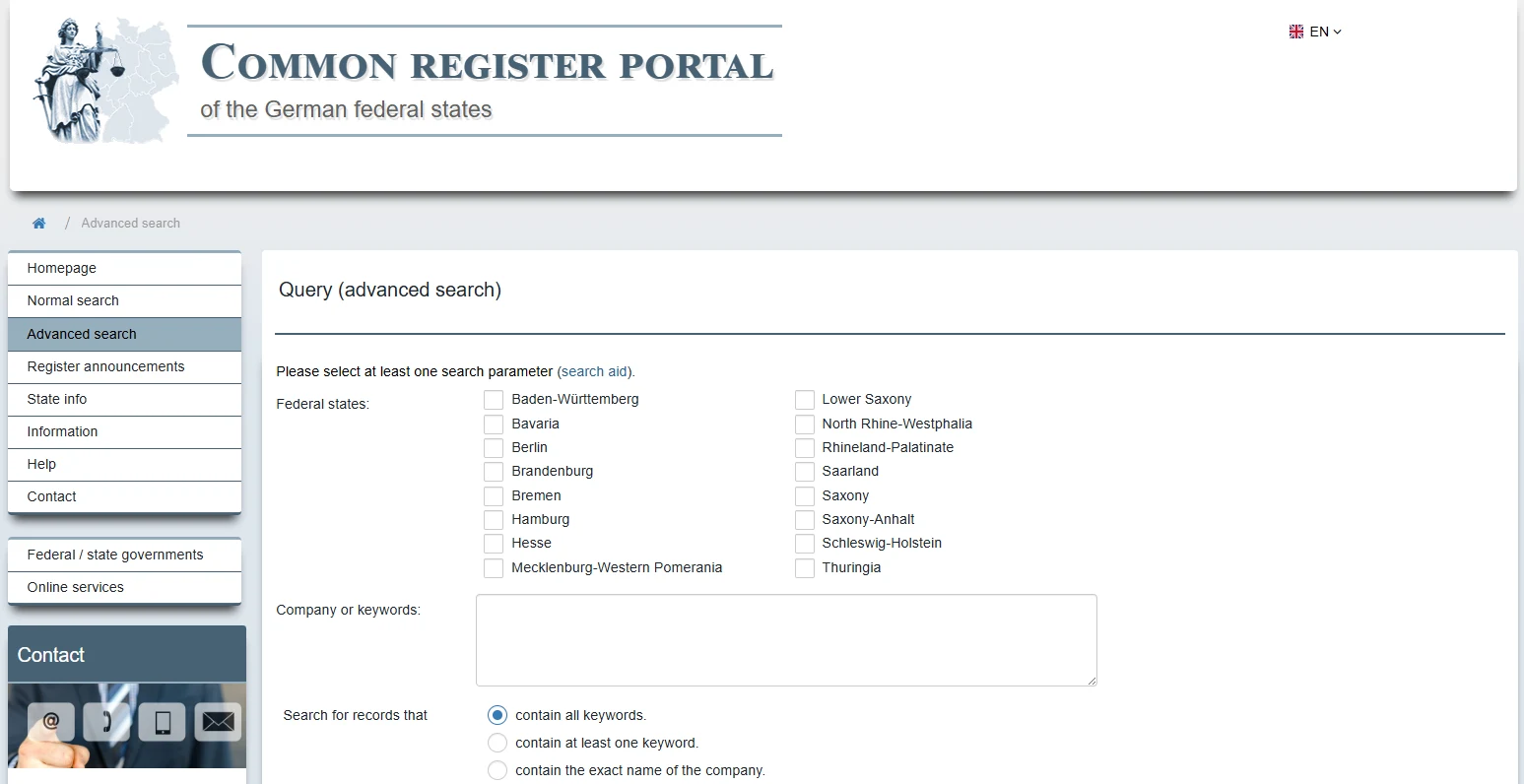
Advanced Search on handelsregister.de: filter by federal state, register type, and keywords. Enter the company name.
Matching is exact, including German characters. If "Müller" returns nothing, try "Mueller". The same goes for ö/oe, ä/ae, and ß/ss. This is the most common reason a known company does not appear.Filter by register type
If needed: HRA for partnerships and sole traders, HRB for capital companies such as GmbH and AG (in plain terms: HRB is where limited companies live).Open the company record.
You see the company name, court of registration, Handelsregisternummer, and status (active or deleted), plus a list of available documents.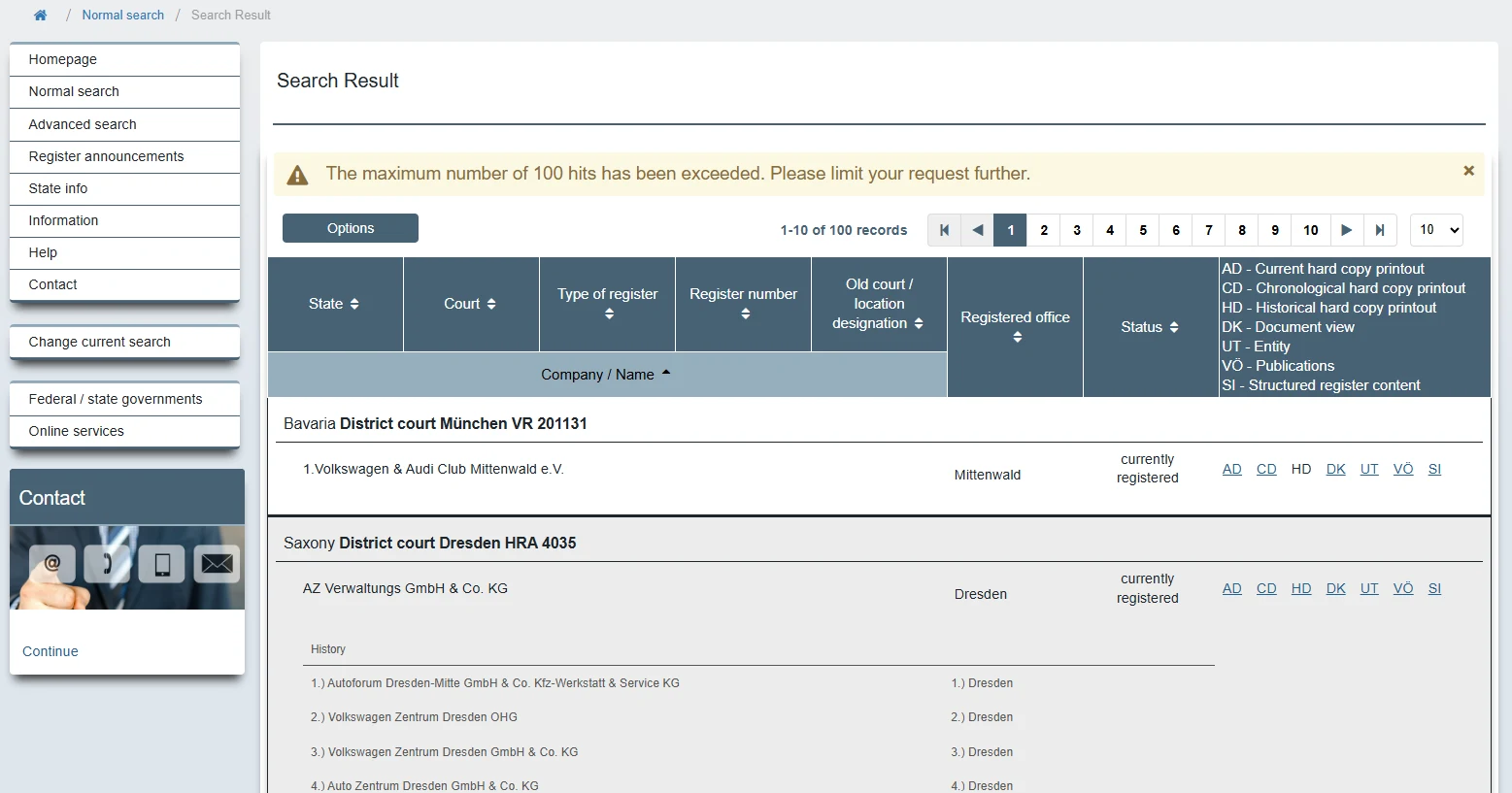
A search for "Volkswagen" exceeds the 100-hit maximum, grouped by federal state. For large companies, Advanced Search with an exact name or register number works better. Download documents free.
The most useful are the AD (Aktueller Ausdruck, current printout with directors and capital), the CD (Chronologischer Ausdruck, the full change history), and the DK (document collection with articles of association and GmbH shareholder lists).
3. What data is public and what it costs
Anyone can access the register without stating a reason. Since August 2022, nearly everything on the register side is free. Fees only appear for certified copies and some financial filings.
| Item | Free or paid | Price |
|---|---|---|
| Company search (name, number, keyword) | Free | €0, no account |
| Current printout (AD) and chronological printout (CD) | Free | €0 since Aug 2022 |
| Articles of association, shareholder lists (DK) | Free | €0, scanned PDFs |
| Financial statements (Unternehmensregister) | Mostly free | ~€1 for microenterprise balance sheets |
| Simple official extract | Paid | ~€10, varies by state |
| Certified (notarised) extract | Paid | ~€20 |
| Transparenzregister UBO lookup | Restricted | Fee + proven legitimate interest |
What you will not find in any German register: revenue figures, employee counts, industry codes, or contact details. The business purpose is a free-text field written by notaries, not a NACE or SIC code.
4. German legal forms, briefly
German law requires every company to carry its legal form in its name, so the suffix tells you the liability structure at a glance.
| Form | Full name | Register | In short |
|---|---|---|---|
| GmbH | Gesellschaft mit beschränkter Haftung | HRB | Private limited company, €25,000 minimum capital. The most common form. |
| UG | Unternehmergesellschaft (haftungsbeschränkt) | HRB | The "mini GmbH" for startups, from €1 capital. |
| AG | Aktiengesellschaft | HRB | Stock corporation, €50,000 minimum capital. Shares can be listed. |
| e.K. | Eingetragener Kaufmann | HRA | Registered sole trader with unlimited personal liability. |
| KG / OHG | Kommanditgesellschaft / Offene Handelsgesellschaft | HRA | Partnerships. The popular GmbH & Co. KG combines a KG with a GmbH as general partner. |
5. How to verify a German company: a practical checklist
Confirm the registration
Search handelsregister.de and match the exact name, legal form, court, and Handelsregisternummer against what the company gave you. Check the status field on the AD printout. For a quick first pass, our free company lookup finds the registration and revenue data in one search.Check directors and signatories
The AD lists managing directors (Geschäftsführer) and who may sign for the company. Verify the person you are dealing with is actually on it.Pull the shareholder list
For a GmbH, download the Gesellschafterliste from the DK collection. It shows direct owners and share amounts. If a shareholder is itself a company, repeat the lookup for that entity.Review the change history
The CD printout shows every change since registration. Watch for recent director swaps, capital changes, or relocations. Germany has an active shelf-company market, so the incorporation date alone says little about operational history.Check financials and insolvency
Search the Unternehmensregister for filed accounts (Rechnungslegungsunterlagen) and insolvency notices. No filings can mean reduced obligations for small companies, or late filing.
6. Limitations of the official register
To be clear: for a handful of lookups, the official portal is the right tool, and it costs nothing. The limits appear when you need scale, structure, or English:
- No API. There is no official programmatic access, and the portal's terms cap usage at 60 queries per hour. Mass automated scraping can even be a criminal offence under German law.
- German only. The interface speaks English, but every document, filing, and financial statement is in German.
- Fragmented across ~150 courts. No single national identifier exists. A company that relocates gets a new number at the new court, creating duplicate entries.
- PDFs, not data. Shareholder lists and articles are scanned documents. Extracting fields means OCR work.
- No firmographics. Revenue, employees, and industry codes are simply not in the register.
If you verify one German supplier a quarter, none of this matters. If you onboard hundreds, it is the whole problem.
7. Access Handelsregister data programmatically
CompanyData maintains a normalized database of all 6,787,743 German legal entities, sourced directly from the Handelsregister and Bundesanzeiger and refreshed as new filings appear. The court-specific identifiers are already reconciled, scanned filings are parsed into structured fields, and records are enriched with revenue, employees, and industry codes that the official register does not publish.
The Handelsregister API lets you look up any German entity by HRB/HRA number, name, or address and get structured JSON back in real time, with 150 free lookups to start. It is part of our global Company Data API, used by developers, banks, and insurers, so German checks work exactly like checks in any of 200+ other countries.
Example: look up a company by registration number
GET /v1/companies?country=DE®istration_id=80333B42243
{
"name": "Bayerische Motoren Werke AG",
"legal_form": "AG",
"registration_id": "80333B42243",
"city": "München",
"status": "active",
"revenue_eur": 142380000000,
"employees": 157110
}8. Germany vs other company registers
Germany publishes more than most countries but is harder to work with than any register with a central database. For context:
| Country | Register | Free search | Official API | Financials public |
|---|---|---|---|---|
| Germany | Handelsregister, ~150 courts | Yes, since 2022 | No | Yes, via Unternehmensregister |
| Argentina | IGJ (Buenos Aires City), per province elsewhere | No, open data and CUIT check only | No, CSV open data (CC BY 4.0) | Paid copy, 6 modules (ARS 9,000) |
| Australia | ASIC + ABR (ABN Lookup) | Yes, incl. sole traders | ABN validation only | Large companies only |
| Austria | Firmenbuch, one FN number | Summary only | No, ten agents resell | Yes, EUR 1.52 per document |
| Belgium | CBE / KBO / BCE | Yes, incl. directors and NACE | Yes, EUR 50 per 2,000 | Yes, free in XBRL |
| Brazil | CNPJ (Receita Federal), one 14-character number per establishment; legal acts at 27 state Juntas Comerciais | By CNPJ only, hCaptcha, incl. QSA | Yes, Serpro, from BRL 0.6591 per lookup; free bulk open data | Listed companies only, free via CVM |
| Bulgaria | Commercial Register (Registry Agency), one 9-digit UIC | Yes, incl. directors and capital | Yes, by contract, from EUR 51.13 | Yes, free download |
| Canada | Corporations Canada + 13 provincial/territorial registries | Yes, incl. directors and ISC | Yes, lookup by number, account needed | Rarely, some distributing corporations |
| Chile | RES (Tu Empresa en un Día) + Registros de Comercio | RES only, behind reCAPTCHA | No; yearly open-data CSV of RES formations | Open and special S.A.s only |
| China | GSXT (SAMR), one 18-character code | Yes, behind a CAPTCHA | None found on GSXT | Ten figures, only if the company opts in |
| Colombia | RUES, 58 chambers of commerce | Basic data, free by law | No; monthly open data on datos.gov.co | Supersociedades filers only (SIIS) |
| Czech Republic | Obchodní rejstřík, 7 courts, one IČO | Yes, incl. extracts, Czech only | Yes, free (ARES REST) | Yes, free as PDF |
| Denmark | CVR, one 8-digit CVR number | Yes, incl. directors and signing rule | Yes, free, by application | Yes, free in XBRL and PDF |
| Estonia | Äriregister via e-Business Register (RIK) | Yes, incl. shareholders and tax data | Yes, free with a RIK contract | Yes, free PDFs + CSV key figures |
| Finland | YTJ + PRH Trade Register, one Business ID | Yes, extract free too | Yes, free open data | Yes, EUR 5.02 per document |
| France | RNE at INPI + Sirene + RCS | Yes, most data | Yes, two, both free | About 45% filed confidentially |
| Greece | GEMI, one 12-digit number | Yes, incl. directors and filings | Yes, key on approval | Yes, free download |
| Hungary | Cégjegyzék, 20 company courts | Yes, CAPTCHA, Hungarian only | XML by contract, paid | Yes, free to view |
| India | MCA21 (MCA), one CIN, 32 RoC offices | CIN lookup only, CAPTCHA | No | Yes, INR 100 to view, login needed |
| Indonesia | AHU Online (Ditjen AHU), searched by name | Name search only, behind reCAPTCHA | None found; bulk IDR 5m per 100 PTs | Audited PTs only by law; access unconfirmed |
| Ireland | CRO, searched on CORE | Yes, profile and filing list | Yes, free (Open Services) + open data | Yes, EUR 2.50 per document |
| Israel | Registrar of Companies (ICA), one 9-digit number | Yes, Hebrew only, no people | Open data only, free (data.gov.il) | No, public companies via MAGNA |
| Italy | Registro Imprese, Chambers of Commerce | Basic data only | Yes, by contract | Yes, EUR 2.50 per filing |
| Japan | Commercial register (MOJ) + NTA corporate number site | Name, address, number only | Yes, free (NTA, ID takes 2-4 weeks) | EDINET filers only |
| Luxembourg | RCS at Luxembourg Business Registers | Record free, filings need a login | Yes, EUR 5,000 a year | Yes, but many forms exempt |
| Malaysia | SSM, sold via 4 service portals | Match count only | No, e-Info API on enquiry | Yes, summary in RM15.40 profile |
| Mexico | Registro Público de Comercio (SIGER 2.0), one folio mercantil electrónico | No, account and CURP required; state fees may apply | No, terms forbid extraction | Rarely, PSM only at shareholders' request (SAS must file) |
| Netherlands | KVK Handelsregister | Search free, extracts paid | Yes, paid | Filed, paid access |
| New Zealand | Companies Register (Companies Office), company number + NZBN | Yes, incl. directors, shareholders, documents | Yes, mostly free (NZBN API no fee) | FMC and large overseas-linked only |
| Norway | Brønnøysundregistrene (CCR + Foretaksregisteret), one 9-digit number | Yes, incl. roles and firmaattest | Yes, free (NLOD 2.0), no sign-up | Yes, free PDF download |
| Poland | KRS, one 10-digit KRS number (+ CEIDG for sole traders) | Yes, extracts free too | Yes, free, no key | Yes, free, XML unless IFRS |
| Portugal | Registo Comercial (IRN), one NIPC | Publications only, record EUR 25 a year | No, FCPC by protocol only | Filed, separate paid certificate |
| Romania | Registrul Comerțului (ONRC), CUI + J/C/F number | Basic record, free account needed | No, free monthly open data instead | Filed; key figures via ANAF by CUI |
| Saudi Arabia | Commercial Register (Ministry of Commerce), one unified national number | Yes, basic data behind a CAPTCHA | Yes, Wathq, SAR 2-12 per call, prepaid from SAR 5,000 | Filed on Qawaem, not in the free search |
| Singapore | ACRA Bizfile, one UEN per entity | Yes, basic record, no login | Yes, paid subscription, prices unpublished | Yes, extracts from S$11; solvent EPCs exempt |
| Slovakia | ORSR, 8 registry courts, one IČO | Yes, incl. directors and s.r.o. partners | Yes, free (Open Data REST) | Yes, free in RÚZ |
| South Korea | Commercial registry (courts, via IROS), 13-digit corporate number | No, KRW 700 per online view | No, statistics API only; bulk data by approval | Audited and listed companies, free on DART |
| Spain | Registro Mercantil, per province | Yes, core record | No | Yes, paid per filing |
| Sweden | Bolagsverket, one organisation number | Basic record, no board | Yes, free basic data; full API paid | Yes, SEK 75; digital AB filings free since 2020 |
| Switzerland | Zefix + 26 cantons | Yes, 4 languages | Yes, free (Zefix REST) | No |
| Taiwan | MOEA findbiz, one 8-digit UBN | Yes, incl. directors' shareholdings | Yes, free (GCIS open data) | Public companies only, via MOPS |
| Thailand | DBD DataWarehouse+, one 13-digit number | Yes, incl. directors (Thai view only) | BDEX, by application, fees set by law | Yes, key figures free, 5 years |
| Turkey | Ticaret Sicili, 238 offices in MERSİS, one MERSİS number | Name check only (image code); notices free with login | No free API; paid gazette web-service feed from TRY 484,932/yr | No accounts search; listed companies on KAP |
| United Arab Emirates | NER (Ministry of Economy) + per-emirate and free zone registers | No national search (UAE PASS); Dubai directory and DIFC free | None found; Dubai licence CSVs on Dubai Pulse (unreachable) | Joint stock companies only |
| United Kingdom | Companies House | Yes | Yes, free | Yes, but often no P&L |
| United States | 50 state registries + SEC EDGAR | Mostly, per state | EDGAR only | SEC filers only |
| Vietnam | National Business Registration Portal (MoF), one enterprise code = tax code | Yes, basic record behind a reCAPTCHA | None found; paid account access (VND 4.5m/month) | Yes, VND 40,000 per copy |