
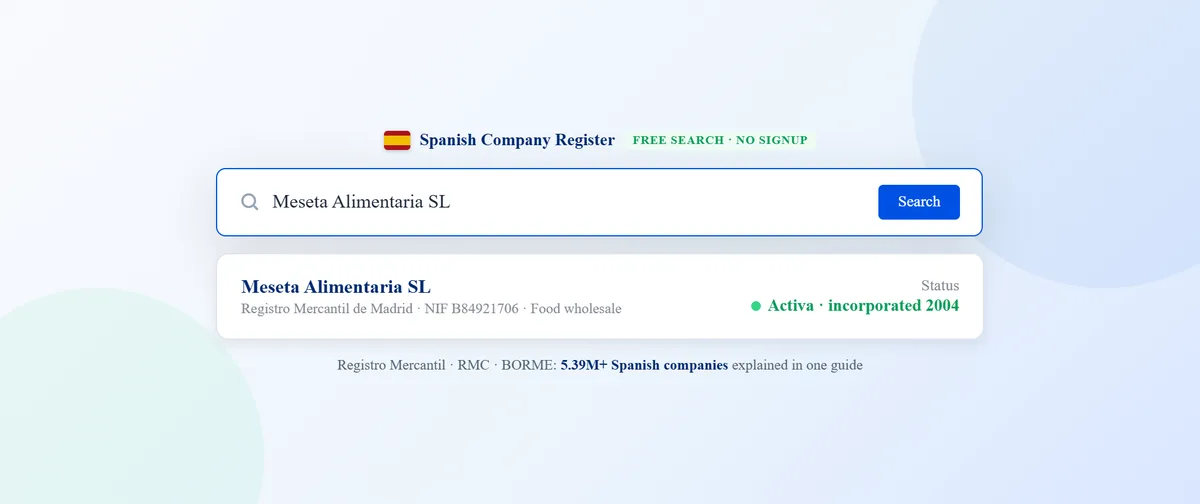
1. How the Spanish company register works
Spain sits between Germany's fragmentation and the UK's single register. The Registro Mercantil is kept province by province by local registrars, so a business is registered where its seat is, identified by a provincial register and sheet number (hoja). But the registrars' association runs shared national portals on top, so in practice you search once, not fifty times.
Three layers matter: the Registradores portals (the free open-data directory and the paid registradores.org document service), the Registro Mercantil Central (rmc.es, the central name index, mainly used to reserve names), and BORME (boe.es), the official gazette that publishes every registration, appointment and dissolution daily, free, and the best tool for reconstructing a company's history.
| Source | What it holds | Access |
|---|---|---|
| Registradores open data opendata.registradores.org | Core record: name, legal form, NIF, EUID, CNAE/NACE, province, status, officers, address | Free, no account |
| Registradores documents registradores.org | Nota informativa mercantil (full extract), certificaciones, deposited annual accounts | Paid: nota from €2.60, certification from €15 |
| BORME boe.es/borme | Daily gazette: incorporations, appointments, capital changes, dissolutions | Free searchable archive |
The join key is the NIF (Número de Identificación Fiscal), format letter plus eight digits, for example B80759939. The letter encodes the legal form: B for an SL, A for an SA. Records also carry the EUID, the EU-wide register identifier that links Spanish entities into the European BRIS network.
2. How to search the Registro Mercantil step by step
The registrars' open-data directory is free and needs no registration. The interface is Spanish-only, but the fields are recognisable.
Open the Directorio de sociedades
Go to the Registradores open-data portal and type the name. A search for "inditex" returns every match with its province, including the dissolved Madrid SL that has nothing to do with the Zara group.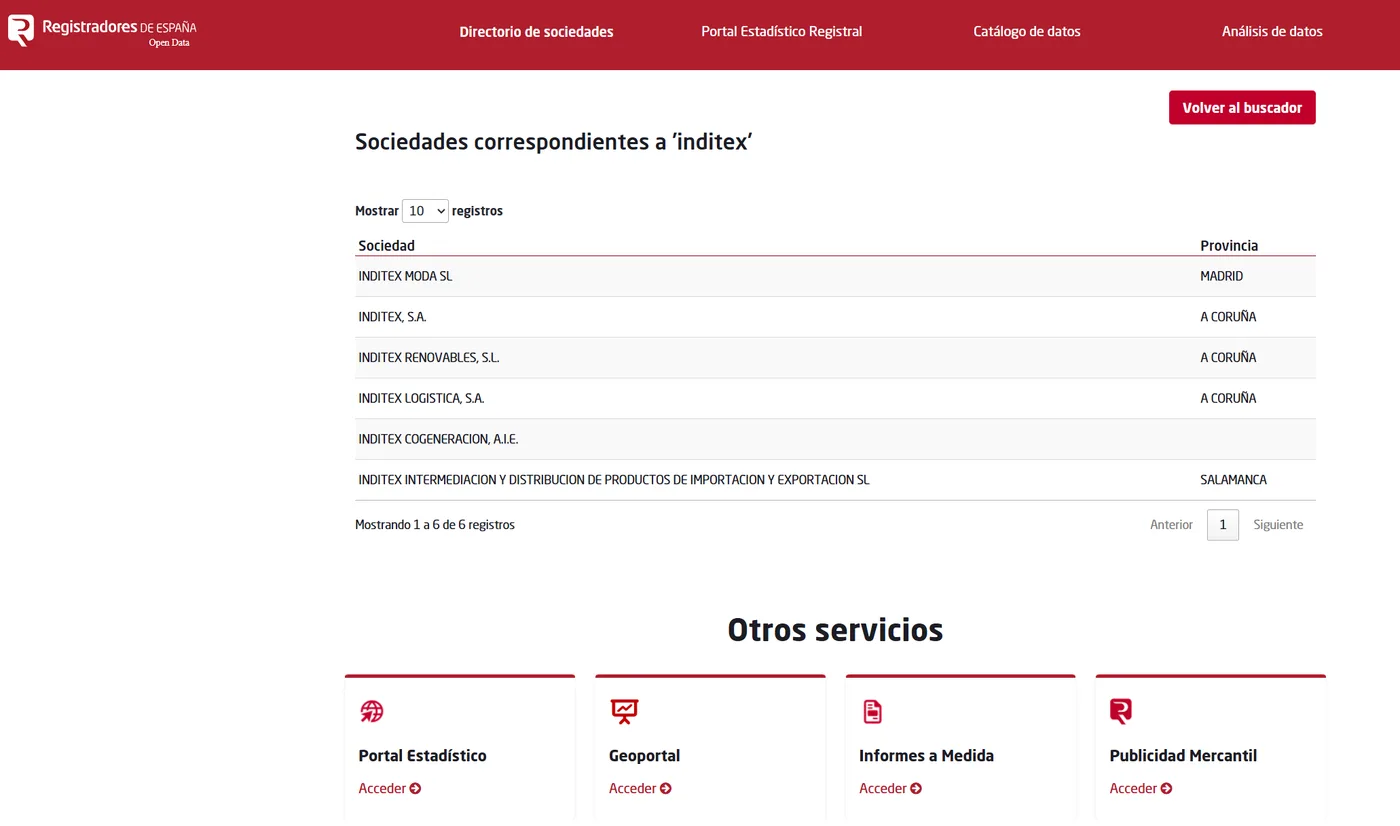
A search for "inditex" returns every matching company with its province, including the dissolved Madrid SL that has nothing to do with the Zara group. Pick the right entity by province and form, not just name
Names recur across provinces, and famous names attract copycats. When in doubt, match the NIF.Open the record
Free of charge you get the legal name, legal form, NIF, EUID, CNAE and NACE activity codes, the sheet number (hoja), the provincial register, website, status, and the current officers.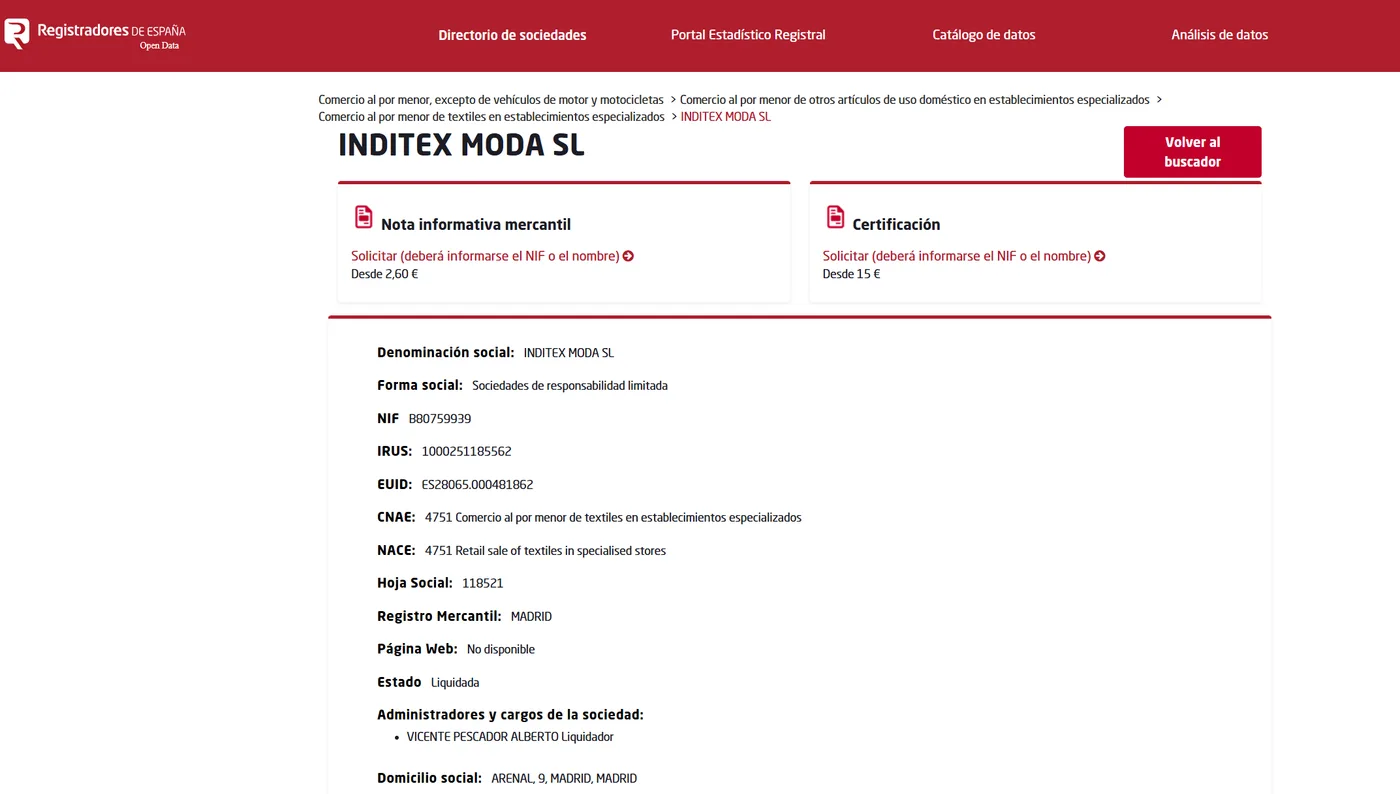
The free record: NIF, EUID, CNAE/NACE codes, register and status ("Liquidada" means this one is wound up), plus officers. Above it, the two paid documents: nota informativa from €2.60, certification from €15. Order the nota informativa mercantil
From €2.60, when you need the full extract: registered details, capital, powers of attorney, and the filing situation. A certified certificación (from €15) adds evidentiary value for banks and courts.Check BORME for the history
The free gazette archive at boe.es shows every published act, from appointments and capital increases to re-registrations and dissolutions, with dates, and is searchable by name.
3. What data is public and what it costs
Spain's model: the index is free, the documents are cheap but metered. Every paid item is ordered per business, per document.
| Item | Free or paid | Price |
|---|---|---|
| Directory search + core record (NIF, CNAE, status, officers) | Free | €0, no account |
| BORME gazette archive | Free | €0, boe.es |
| Nota informativa mercantil (full extract) | Paid | From €2.60 |
| Deposited annual accounts (per year) | Paid | A few euros per filing |
| Certificación (certified extract) | Paid | From €15 |
| RMC name certificate (name reservation) | Paid | A few euros, rmc.es |
| Beneficial owners (UBO) | Restricted | Central UBO register: authorities and legitimate interest |
Good news buried in there: unlike Switzerland, Spain does publish financial statements. Every registered entity deposits annual accounts with its provincial register. The friction is the retail model: one business, one year, one order, one fee.
4. Spanish legal forms, briefly
The suffix, and the first letter of the NIF, tells you the structure.
| Form | NIF starts with | In short |
|---|---|---|
| SL / SRL | B | Sociedad limitada, the default private form. Minimum capital effectively €1 since 2022. The vast majority of the register. |
| SA | A | Sociedad anónima, €60,000 minimum capital. Larger firms; only some are listed. |
| SLU / SAU | B / A | Single-shareholder variants. The U (unipersonal) must be disclosed, a useful ownership hint the register gives you free. |
| Cooperativa / asociación | F / G | Cooperatives and associations, partly in separate registers. |
| Autónomo | Personal NIF | Sole trader. Registration in the Registro Mercantil is voluntary and rare, so millions of autónomos are absent from it. |
5. How to verify a Spanish company: a practical checklist
Confirm the registration
Look the entity up in the free directory and match name, NIF, legal form and province against what you were given. Check the Estado field: "Liquidada" means wound up. For a quick first pass with revenue data included, use our free company lookup.Verify the officers
The free record lists administrators and their roles. Watch the role names: a liquidador means the entity is being wound up; an administrador único can bind it alone.Order the nota and the accounts
For anything contractual, spend the €2.60: the nota shows capital, powers and pending situations. Add the latest deposited accounts to see the balance sheet, and whether accounts are being deposited at all.Read the BORME trail
Search the name at boe.es: frequent officer changes, capital reductions or a recent seat move are the patterns worth questioning. Insolvency (concurso de acreedores) also surfaces here.Cross-check the tax side
For invoicing, validate the NIF as a VAT number via the EU's VIES service. A business can be registered yet deregistered for VAT, which matters for cross-border deals.
6. Limitations of the official register
For single checks, the Spanish setup is decent and cheap. The limits show at scale:
- Everything beyond the index is metered. Extracts and accounts are ordered per business, per year, per fee. Screening a portfolio of hundreds of suppliers means hundreds of small orders.
- Shareholders are not public. The register shows officers, not owners; the central UBO register is restricted to authorities, obliged entities and proven legitimate interest.
- No official API. The portals are built for manual lookups; there is no public programmatic access to the register.
- Spanish only. Records, notas and accounts are in Spanish and the regional co-official languages.
- Accounts lag. Deposits are due up to seven months after year end, so the newest figures can be well over a year old, and small entities file abridged formats.
One Spanish counterparty costs you ten minutes and €2.60. A market view of Spanish businesses, with revenue you can filter on, is where the official sources stop.
7. Access Spanish register data programmatically
There is no official Registro Mercantil API. The portals are built for humans ordering documents one at a time. CompanyData maintains records for all 5,428,173 Spanish businesses, sourced from the Registro Mercantil, BORME and other official sources, with NIF, CNAE codes, officers, and revenue and employee figures as structured fields you can filter on.
The Company Data API serves them by NIF, name or address, with free trial credits to start, and the same request works for 200+ other countries, from Companies House to the Handelsregister.
Example: look up a company by NIF
GET /api/company/search?nationalId=B80759939

{
  "name": "INDITEX MODA SL",
  "legalForm": "Sociedad de responsabilidad limitada",
  "nif": "B80759939",
  "city": "Madrid, Spain",
  "status": "Liquidated",
  "cnae": "4751 · Retail sale of textiles",
  "employees": "1 to 10",
  "revenueRange": "< €1M"
}
8. Spain vs other company registers
Spain lands in the European middle: free index, cheap paid documents, public accounts, private shareholders.
| Country | Register | Free search | Official API | Financials public |
|---|---|---|---|---|
| Spain | Registro Mercantil, per province | Yes, core record | No | Yes, paid per filing |
| Argentina | IGJ (Buenos Aires City), per province elsewhere | No, open data and CUIT check only | No, CSV open data (CC BY 4.0) | Paid copy, 6 modules (ARS 9,000) |
| Australia | ASIC + ABR (ABN Lookup) | Yes, incl. sole traders | ABN validation only | Large companies only |
| Austria | Firmenbuch, one FN number | Summary only | No, ten agents resell | Yes, EUR 1.52 per document |
| Belgium | CBE / KBO / BCE | Yes, incl. directors and NACE | Yes, EUR 50 per 2,000 | Yes, free in XBRL |
| Brazil | CNPJ (Receita Federal), one 14-character number per establishment; legal acts at 27 state Juntas Comerciais | By CNPJ only, hCaptcha, incl. QSA | Yes, Serpro, from BRL 0.6591 per lookup; free bulk open data | Listed companies only, free via CVM |
| Bulgaria | Commercial Register (Registry Agency), one 9-digit UIC | Yes, incl. directors and capital | Yes, by contract, from EUR 51.13 | Yes, free download |
| Canada | Corporations Canada + 13 provincial/territorial registries | Yes, incl. directors and ISC | Yes, lookup by number, account needed | Rarely, some distributing corporations |
| Chile | RES (Tu Empresa en un Día) + Registros de Comercio | RES only, behind reCAPTCHA | No; yearly open-data CSV of RES formations | Open and special S.A.s only |
| China | GSXT (SAMR), one 18-character code | Yes, behind a CAPTCHA | None found on GSXT | Ten figures, only if the company opts in |
| Colombia | RUES, 58 chambers of commerce | Basic data, free by law | No; monthly open data on datos.gov.co | Supersociedades filers only (SIIS) |
| Czech Republic | Obchodní rejstřík, 7 courts, one IČO | Yes, incl. extracts, Czech only | Yes, free (ARES REST) | Yes, free as PDF |
| Denmark | CVR, one 8-digit CVR number | Yes, incl. directors and signing rule | Yes, free, by application | Yes, free in XBRL and PDF |
| Estonia | Äriregister via e-Business Register (RIK) | Yes, incl. shareholders and tax data | Yes, free with a RIK contract | Yes, free PDFs + CSV key figures |
| Finland | YTJ + PRH Trade Register, one Business ID | Yes, extract free too | Yes, free open data | Yes, EUR 5.02 per document |
| France | RNE at INPI + Sirene + RCS | Yes, most data | Yes, two, both free | About 45% filed confidentially |
| Germany | Handelsregister, ~150 courts | Yes, since 2022 | No | Yes, via Unternehmensregister |
| Greece | GEMI, one 12-digit number | Yes, incl. directors and filings | Yes, key on approval | Yes, free download |
| Hungary | Cégjegyzék, 20 company courts | Yes, CAPTCHA, Hungarian only | XML by contract, paid | Yes, free to view |
| India | MCA21 (MCA), one CIN, 32 RoC offices | CIN lookup only, CAPTCHA | No | Yes, INR 100 to view, login needed |
| Indonesia | AHU Online (Ditjen AHU), searched by name | Name search only, behind reCAPTCHA | None found; bulk IDR 5m per 100 PTs | Audited PTs only by law; access unconfirmed |
| Ireland | CRO, searched on CORE | Yes, profile and filing list | Yes, free (Open Services) + open data | Yes, EUR 2.50 per document |
| Israel | Registrar of Companies (ICA), one 9-digit number | Yes, Hebrew only, no people | Open data only, free (data.gov.il) | No, public companies via MAGNA |
| Italy | Registro Imprese, Chambers of Commerce | Basic data only | Yes, by contract | Yes, EUR 2.50 per filing |
| Japan | Commercial register (MOJ) + NTA corporate number site | Name, address, number only | Yes, free (NTA, ID takes 2-4 weeks) | EDINET filers only |
| Luxembourg | RCS at Luxembourg Business Registers | Record free, filings need a login | Yes, EUR 5,000 a year | Yes, but many forms exempt |
| Malaysia | SSM, sold via 4 service portals | Match count only | No, e-Info API on enquiry | Yes, summary in RM15.40 profile |
| Mexico | Registro Público de Comercio (SIGER 2.0), one folio mercantil electrónico | No, account and CURP required; state fees may apply | No, terms forbid extraction | Rarely, PSM only at shareholders' request (SAS must file) |
| Netherlands | KVK Handelsregister | Search free, extracts paid | Yes, paid | Filed, paid access |
| New Zealand | Companies Register (Companies Office), company number + NZBN | Yes, incl. directors, shareholders, documents | Yes, mostly free (NZBN API no fee) | FMC and large overseas-linked only |
| Norway | Brønnøysundregistrene (CCR + Foretaksregisteret), one 9-digit number | Yes, incl. roles and firmaattest | Yes, free (NLOD 2.0), no sign-up | Yes, free PDF download |
| Poland | KRS, one 10-digit KRS number (+ CEIDG for sole traders) | Yes, extracts free too | Yes, free, no key | Yes, free, XML unless IFRS |
| Portugal | Registo Comercial (IRN), one NIPC | Publications only, record EUR 25 a year | No, FCPC by protocol only | Filed, separate paid certificate |
| Romania | Registrul Comerțului (ONRC), CUI + J/C/F number | Basic record, free account needed | No, free monthly open data instead | Filed; key figures via ANAF by CUI |
| Saudi Arabia | Commercial Register (Ministry of Commerce), one unified national number | Yes, basic data behind a CAPTCHA | Yes, Wathq, SAR 2-12 per call, prepaid from SAR 5,000 | Filed on Qawaem, not in the free search |
| Singapore | ACRA Bizfile, one UEN per entity | Yes, basic record, no login | Yes, paid subscription, prices unpublished | Yes, extracts from S$11; solvent EPCs exempt |
| Slovakia | ORSR, 8 registry courts, one IČO | Yes, incl. directors and s.r.o. partners | Yes, free (Open Data REST) | Yes, free in RÚZ |
| South Korea | Commercial registry (courts, via IROS), 13-digit corporate number | No, KRW 700 per online view | No, statistics API only; bulk data by approval | Audited and listed companies, free on DART |
| Sweden | Bolagsverket, one organisation number | Basic record, no board | Yes, free basic data; full API paid | Yes, SEK 75; digital AB filings free since 2020 |
| Switzerland | Zefix + 26 cantons | Yes, 4 languages | Yes, free (Zefix REST) | No |
| Taiwan | MOEA findbiz, one 8-digit UBN | Yes, incl. directors' shareholdings | Yes, free (GCIS open data) | Public companies only, via MOPS |
| Thailand | DBD DataWarehouse+, one 13-digit number | Yes, incl. directors (Thai view only) | BDEX, by application, fees set by law | Yes, key figures free, 5 years |
| Turkey | Ticaret Sicili, 238 offices in MERSİS, one MERSİS number | Name check only (image code); notices free with login | No free API; paid gazette web-service feed from TRY 484,932/yr | No accounts search; listed companies on KAP |
| United Arab Emirates | NER (Ministry of Economy) + per-emirate and free zone registers | No national search (UAE PASS); Dubai directory and DIFC free | None found; Dubai licence CSVs on Dubai Pulse (unreachable) | Joint stock companies only |
| United Kingdom | Companies House | Yes | Yes, free | Yes, but often no P&L |
| United States | 50 state registries + SEC EDGAR | Mostly, per state | EDGAR only | SEC filers only |
| Vietnam | National Business Registration Portal (MoF), one enterprise code = tax code | Yes, basic record behind a reCAPTCHA | None found; paid account access (VND 4.5m/month) | Yes, VND 40,000 per copy |